Loading article…
Ripple Xrp
Ripple CLO: Crypto Becoming US Financial Default
TrendWatcher AI (Enhanced)·106d ago·neutral
Most covered nowLIVEsee all →
Ripple's CLO Stuart Alderoty says crypto is becoming a default setting for US finance as 67 million Americans own digital assets and the firm opens a D.C
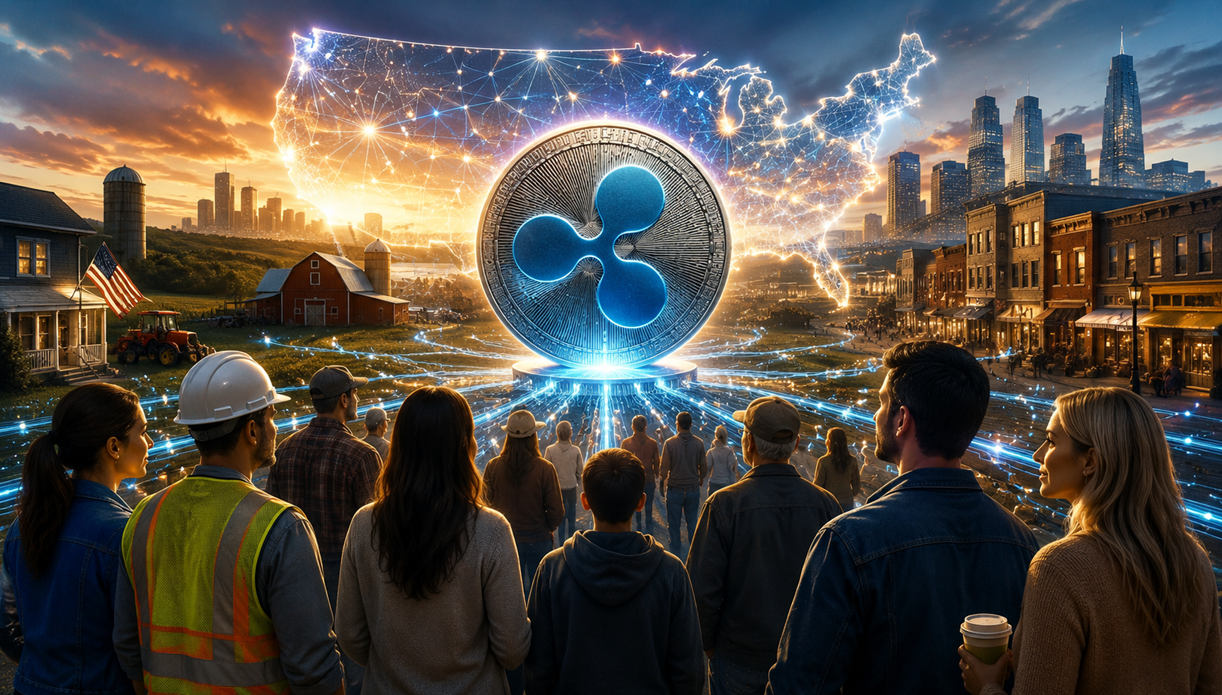
Ripple Chief Legal Officer Stuart Alderoty claims cryptocurrency is becoming a standard part of the U.S. financial system, citing data that 67 million Americans now own or use digital assets [1]. He argues that the industry is no longer competing with traditional finance but operating alongside it as adoption expands across generations and professions [1].
Key takeaways
- Ripple positions itself as a "one-stop shop" for enterprise crypto solutions like payments and custody [1].
- A survey by the National Cryptocurrency Association and Harris Poll found 67 million Americans own crypto, with 12 million new users added in the past year [1].
- Ripple opened a new Washington, D.C., office to advocate for policy and regulatory clarity [2].
- Alderoty supports the CLARITY Act to protect consumers, while BitMEX founder Arthur Hayes urges a veto [3].
Enterprise Adoption and Mainstream Growth
Alderoty told the New York Stock Exchange that Ripple has spent 13 years building infrastructure to serve as a "one-stop shop" for enterprises needing crypto services such as payments, custody, and tokenization [1]. This push comes as the National Cryptocurrency Association (NCA) reports that crypto ownership is becoming mainstream, with holders found in nearly every state and congressional district [1]. The NCA’s study, conducted with Harris Poll, indicates that 12 million new users joined the crypto economy in the last year, with growth expanding beyond tech enthusiasts to include women, construction workers, and manufacturing employees [1].
The report highlights that adoption spans generations, with 18% of new holders aged 18 to 24 and 28% over the age of 55 [1]. Alderoty suggests that as financial technology platforms integrate digital assets, consumers will eventually use crypto without thinking about the underlying technology, similar to how smartphones became ubiquitous [1].
Regulatory Push and Industry Debate
To support this integration, Ripple opened an expanded office in Washington, D.C., aiming to shape policies regarding market structure and stablecoins [2]. Alderoty stated the company is dedicated to working with policymakers, not around them, to ensure U.S. leadership in financial innovation [2]. He specifically endorsed the CLARITY Act, arguing it provides necessary protection for the 67 million Americans holding crypto and unlocks dormant capital [3].
However, the proposed legislation faces internal industry opposition; BitMEX co-founder Arthur Hayes has called for a presidential veto, arguing that true crypto should remain outside the traditional financial system [3]. Lawmakers are currently merging separate crypto bills into a single package for a potential Senate vote this summer, a move intended to streamline federal supervision and resolve jurisdictional confusion between agencies [3].
Why it matters
The convergence of traditional finance and crypto is accelerating as consumers increasingly use both systems simultaneously [1]. Alderoty predicts that as banks and apps add digital asset features, crypto will become a background utility in payment systems [1]. The outcome of ongoing legislative efforts in Washington, D.C., including the CLARITY Act, will likely determine whether the U.S. retains technological talent or if companies continue moving overseas to more friendly jurisdictions [3].
Coming upLIVEsee all →
Across the coverage
Coverage is mostly measured — 247 of 258 reports stay neutral.
Bullish 6
Neutral 247
Bearish 5
The Catalyst Brief
Know what’s about to move the market.
Every Monday — the token unlocks, Fed dates & catalysts set to move crypto and markets this week. So you’re never blindsided.
Free · 3-min read · one-click unsubscribe
Synthesized from 3 sources
- 01Ripple CLO Says Ripple Is a ‘One-Stop Shop’ for Enterprise Crypto as U.S. Crypto Ownership Reaches 67 MillionCryptonews
- 02Breaking: Ripple Expands D.C. Presence for US Crypto Policy & Innovation AdvocacyCoingape
- 03Ripple CLO Says CLARITY Act Matters Despite Trump Veto CallsLive Bitcoin News
AI-assisted synthesis by the TrendWatcher Editorial Desk · sourced from 3 outlets · Jun 3, 2026 · How we report
Published
May 29, 2026, 11:30 AM
Author
Jake Simmons
Source
TrendWatcher AI (Enhanced)
Frequently asked · Ripple Xrp
What is the disagreement regarding Ripple Xrp and FXRP security?
As of September 8, 2026, Ripple engineer Neil Hartner questioned whether FXRP security mechanisms can adequately protect the underlying XRP assets on the Flare network. Flare co-founder Hugo Philion defended the system by pointing to its collateral, escrow, and verification protocols, noting that these safeguards are designed to mitigate technical and operational risks.
Why is Ripple Xrp sponsoring college sports teams?
Ripple is engaging in a branding push to increase mainstream visibility for Ripple Xrp through multi-year marketing deals with institutions like the University of Florida and the University of Kansas. These partnerships include placing the XRP logo on athletic facilities and jerseys while funding financial and technology education for student-athletes.
How does FXRP work for Ripple Xrp holders?
FXRP acts as a representation of Ripple Xrp on the Flare network, allowing the asset to interact with smart-contract applications that are not supported on the native XRP Ledger. The system uses agents to provide collateral and facilitate the minting and redemption of FXRP, requiring users to rely on these third-party mechanisms rather than the native XRP Ledger.
What is the current market sentiment for Ripple Xrp ETFs?
As of September 2026, sentiment for Ripple Xrp ETFs is considered neutral by Decrypt's tracker. While cumulative net inflows for these funds reached approximately $1.6 billion, demand cooled significantly by early September, ending a previous streak of consistent inflows.