Loading article…
Stock To Flow
Aeternum Blade custom Harley chopper unveiled by Rough Crafts
TrendWatcher AI (Enhanced)·123d ago·neutral
Most covered nowLIVEsee all →
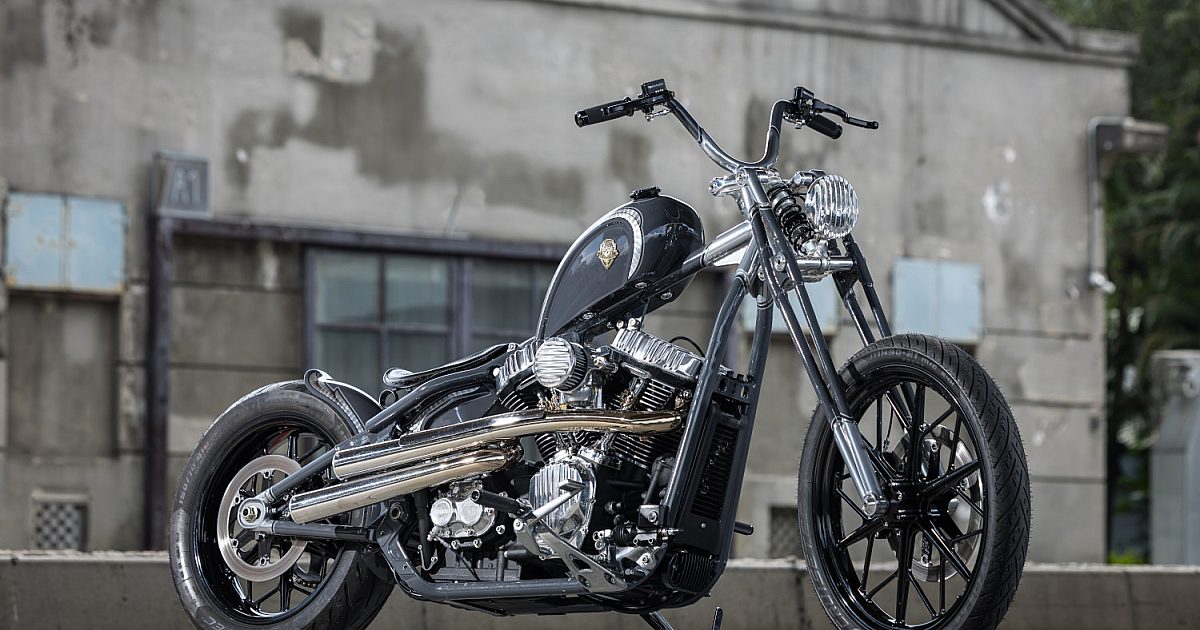
Rough Crafts transforms a 2024 Harley‑Davidson Street Bob into the Aeternum Blade chopper, featuring a 128 ci engine and bespoke girder fork.
The Aeternum Blade, a fully reimagined 2024 Harley‑Davidson Street Bob, debuted with a 128 ci (2,097 cc) S&S big‑bore engine and a custom girder fork that blends CNC‑machined, 3D‑printed and hand‑crafted parts, marking a radical departure from the stock model [2].
| At a glance | |
|---|---|
| Base model | 2024 Harley‑Davidson Street Bob |
| Engine displacement | 128 ci (2,097 cc) big‑bore kit |
| Suspension | Custom girder fork with Öhlins HD207 damper; Öhlins HD503 rear shock |
| Paint | Nardo Grey with silver‑leaf graphics by Rover Works Custom Paint |
Frame and geometry overhaul
Rough Crafts began by cutting the Street Bob’s stamped neck and square backbone, welding a tubular backbone, and raising the steering head 2.5 inches while moving it 0.5 inches forward, while retaining the original 30° rake. This creates a compact, forward‑leaning stance reminiscent of classic choppers yet remains maneuverable [2]. The bespoke girder fork, a skeletal assembly of CNC‑machined billet aluminum, 3D‑printed components and handcrafted elements, houses an Öhlins HD207 damper, reviving a pre‑1940s suspension design with modern performance [2].
Powertrain and component upgrades
The stock Milwaukee‑Eight engine was replaced with a 128 ci S&S Cycle big‑bore kit, boosting displacement to 2,097 cc. Instead of the factory electronic fuel injection, the build uses an S&S Super E carburetor fed through an Altmann conversion kit and a Rough Crafts‑branded air filter, restoring a raw, mechanical character [2]. Additional performance parts include a Baker hydraulic clutch housing, an open primary from Belt Drives Ltd., and a custom chain drive with an RK Takasago chain and a bespoke rear sprocket. The bike rides on 21‑inch front and 18‑inch rear Fatboy Design wheels shod with Metzeler Cruisetec tires, and features Beringer six‑piston front and four‑piston rear brakes with custom disc carriers [1].
Aesthetic and finishing touches
The chassis received a two‑tone powder‑coat finish that mimics a vintage lugged frame, while Rover Works Custom Paint applied a Nardo Grey livery accented by silver‑leaf graphics. The cockpit is dominated by direct‑mount Frisco‑style handlebars, Lowbrow Customs grips, and Rough Crafts‑branded pegs. A petite, scalloped‑sided fuel tank with a Rough Crafts filler cap sits above a bobbed saddle from Rich Phillips Seat Co., and the bike’s exhausts are hand‑finished Rough Crafts pieces. A small Motogadget speedometer floats between the massive cylinder heads, supported by a handmade bracket [1].
What to watch
- Upcoming showcase events where Rough Crafts may display the Aeternum Blade, potentially influencing demand for high‑end custom chopper components.
- Release of detailed performance figures (horsepower, torque) for the 128 ci S&S conversion, which could set new benchmarks for custom Harley builds.
- Any future collaborations between Rough Crafts and component makers (e.g., Öhlins, Beringer) that might introduce new aftermarket suspension solutions.
The Aeternum Blade demonstrates how a stripped‑down Harley platform can be transformed into a precision‑engineered chopper, blending classic aesthetics with cutting‑edge suspension technology, and raises questions about the future of bespoke motorcycle engineering in a market dominated by factory models.
Coming upLIVEsee all →
Across the coverage
Coverage is mostly measured — 124 of 135 reports stay neutral.
Bullish 7
Neutral 124
Bearish 4
The Catalyst Brief
Know what’s about to move the market.
Every Monday — the token unlocks, Fed dates & catalysts set to move crypto and markets this week. So you’re never blindsided.
Free · 3-min read · one-click unsubscribe
Synthesized from 2 sources
- 01Creative Prowess: Rough Crafts Delivers a Vivid Harley... - PipeburnPipeburn
- 02Aeternum Blade: Rough Crafts Transforms the Harley-Davidson...Motorcycles
AI-assisted synthesis by the TrendWatcher Editorial Desk · sourced from 2 outlets · Jun 18, 2026 · How we report
Published
May 16, 2026, 06:00 PM
Author
[email protected] (Tom Gosselin)
Source
TrendWatcher AI (Enhanced)
Frequently asked · Stock To Flow
What is the Stock To Flow model for Bitcoin?
The Stock-to-Flow model is a valuation framework that estimates the price of Bitcoin based on its scarcity, defined as the ratio between the total existing supply and the new supply produced through mining. It treats Bitcoin as a store-of-value commodity similar to precious metals like gold.
How does the Stock To Flow model work with Bitcoin halvings?
The Stock-to-Flow model incorporates Bitcoin halving events, which occur every 210,000 blocks, to account for the reduction in new supply entering the market. Because the model assumes that increased scarcity leads to higher prices, it projects price increases following these scheduled reductions in mining rewards.
Is the Stock To Flow model an accurate way to predict Bitcoin price?
The Stock-to-Flow model is not considered a reliable standalone price prediction tool because Bitcoin's market price has frequently deviated from its projections in recent years. While it was influential in earlier market cycles, many investors now treat the Stock-to-Flow model as a historical reference rather than a precise forecasting tool.
Who created the Stock To Flow model?
The Stock-to-Flow model is associated with an anonymous individual known as Plan B, who communicates primarily via Twitter. The name refers to the concept of Bitcoin acting as an alternative to the existing government-controlled monetary system.