Loading article…
Ethereum
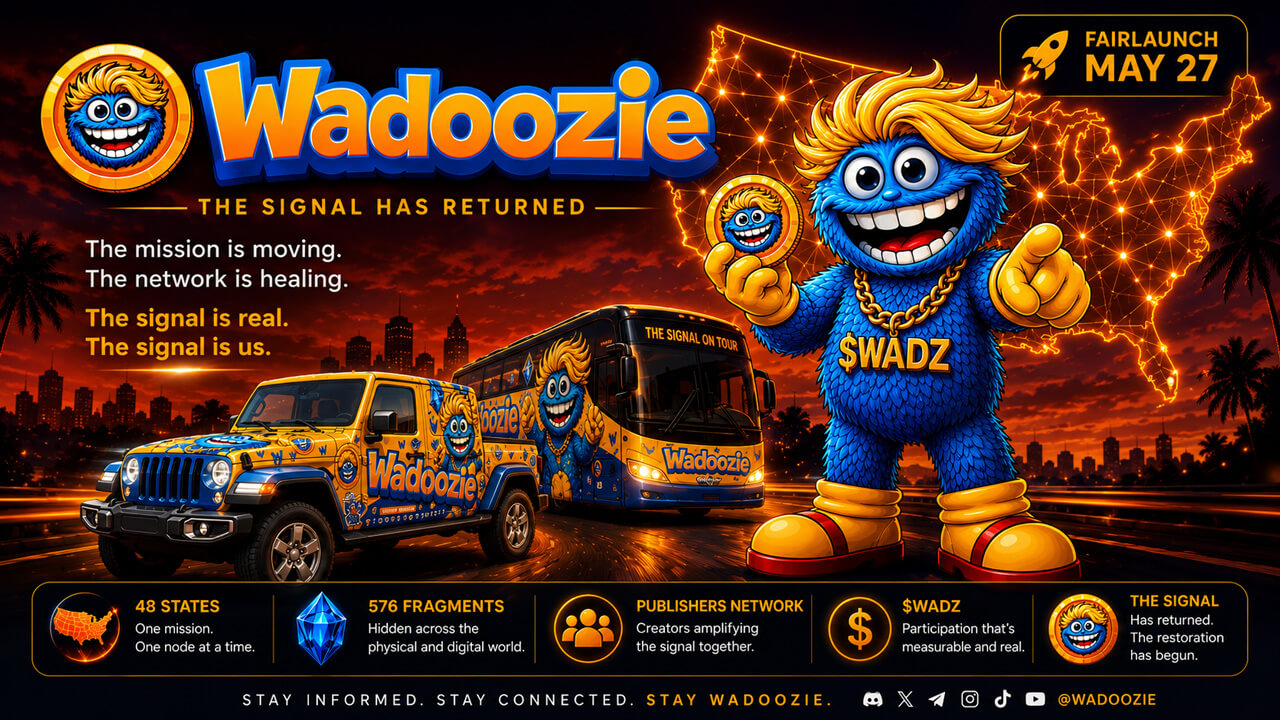
Wadoozie launches $WADZ with 48‑state tour and 576 hidden token
TrendWatcher AI (Enhanced)·123d ago·neutral
Most covered nowLIVEsee all →
Wadoozie’s $WADZ memecoin debuts May 27, 2026, featuring a real bus tour across 48 US states, 576 claimable Signal Fragments and a 7% creator payout pool.
A narrative‑driven Ethereum token called $WADZ went live on May 27, 2026, kicking off a physical tour bus that will travel through all 48 contiguous U.S. states while dropping 576 hidden “Signal Fragments” redeemable for token rewards [2].
The project’s litepaper frames the tour as the core of an on‑chain attention network: each state acts as a “node” that activates when the bus arrives, and participants hunt for fragments that range from common (15,375 $WADZ each) to legendary (461,250 $WADZ each) [1]. Seven fragments are hidden in every state, guaranteeing at least one legendary reward per state, while an additional 240 fragments reside in an online pool accessed via puzzles, QR codes and community events [1].
Tokenomics are deliberately simple. Two billion $WADZ were minted at genesis, with 999,999,999 burned at launch, leaving an effective circulating supply of 1,000,000,001 tokens [2]. Seventy‑five percent of that supply sits in a DAO‑governed, locked liquidity pool paired with ETH, and the contract is renounced, meaning no individual or team wallet can move the LP without a community vote [2]. Ten percent is allocated to a multi‑sig treasury, seven percent (70 million tokens) to a “Publishers Network” that pays creators who clip, post or remix mission content, and five percent funds the Signal Fragment prize pool [1][2]. The team holds 3% of tokens, locked for a full year [2].
The launch price is set by a transparent formula: market cap divided by one billion. At the $62,500 launch FDV, $WADZ trades at $0.0000625, so a $100 position buys 1.6 million tokens [1]. If the market cap reaches $100 million, that same position would be worth $160,000; at a $1 billion cap, it would be $1.6 million [1].
Execution risk is high. The tour’s eight‑act narrative, beginning in Austin and ending in New Orleans, demands real‑world logistics across 48 states, and the value of the hidden fragments depends on whether participants can actually locate and claim them before any default burn mechanism kicks in [1]. Likewise, the 7% creator pool only matters if the Publishers Center can consistently review and reward content as the community scales [1].
If the bus stays on schedule and the fragment hunts deliver the promised token payouts, $WADZ could become a live test of location‑based scarcity and creator‑driven economics on Ethereum; if not, the ambitious model may struggle to sustain interest beyond the initial hype.
Coming upLIVEsee all →
Across the coverage
Coverage is mostly measured — 283 of 300 reports stay neutral.
Bullish 10
Neutral 283
Bearish 7
The Catalyst Brief
Know what’s about to move the market.
Every Monday — the token unlocks, Fed dates & catalysts set to move crypto and markets this week. So you’re never blindsided.
Free · 3-min read · one-click unsubscribe
Synthesized from 2 sources
- 01The Signal Has Returned: Inside Wadoozie, the $WADZ MissionCryptosurges
- 02Wadoozie ($WADZ): The Ethereum Memecoin With a 48-State TourBlockwiseon
AI-assisted synthesis by the TrendWatcher Editorial Desk · sourced from 2 outlets · Jun 16, 2026 · How we report
Published
May 15, 2026, 03:45 PM
Author
News Desk
Source
TrendWatcher AI (Enhanced)
Frequently asked · Ethereum
How much Ethereum does Bitmine Immersion Technologies own?
Bitmine Immersion Technologies held 5,956,378 Ethereum tokens as of late August 2026. These holdings are valued at approximately $14.89 billion.
What percentage of the total Ethereum supply does Bitmine hold?
Bitmine Immersion Technologies holds approximately 4.9% of the total Ethereum supply as of late August 2026. The company is approaching a stated goal of owning 5% of the total supply.
Is Bitmine staking its Ethereum holdings?
Yes, approximately 85% of the Ethereum held by Bitmine Immersion Technologies is currently staked. This staking activity is projected to generate $334 million in annualized revenue for the company.
How has Ethereum performed compared to other assets in 2026?
Ethereum is described as the best-performing macro asset during the third quarter of 2026, according to statements from Bitmine Chairman Tom Lee. As of late August 2026, Ethereum outperformed the S&P 500 by 5,866 basis points.