Loading article…
Ethereum
US Inflation Rises to 3.8% in April, Highest in Three Years
TrendWatcher AI (Enhanced)·123d ago·bullish
Most covered nowLIVEsee all →
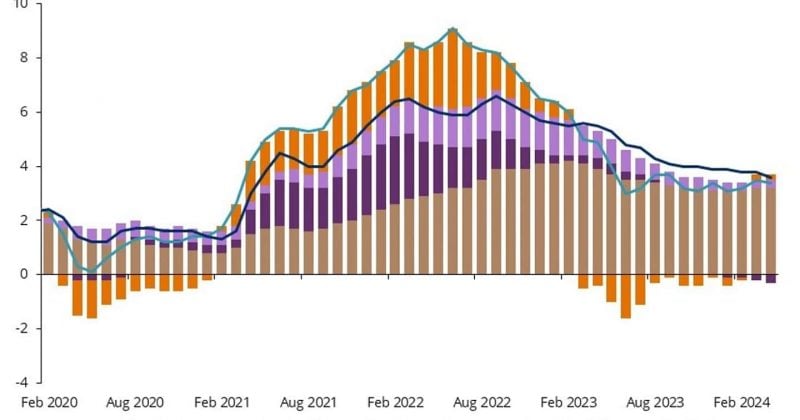
US inflation hit 3.8% in April, the highest level in nearly three years, driven by energy, food, and shelter costs. Consumer spending rose 0.5% despite flat
US consumer inflation rose to 3.8% in April, marking its highest annual rate in nearly three years [2]. This figure exceeded market expectations of 3.7% and followed a 3.3% rate in March [1]. The Personal Consumption Expenditures (PCE) price index, the Federal Reserve's preferred inflation gauge, increased 0.4% from the previous month [2].
Energy prices jumped 17.9% year-on-year in April, while food and shelter costs climbed 3.2% and 3.3% respectively [1]. On a monthly basis, consumer prices rose 0.6%, with energy accounting for over 40% of that increase [1]. The shelter index increased 0.6% and food rose 0.5% month-over-month [1]. Core PCE, which excludes volatile food and energy prices, increased 3.3% year-on-year and 0.2% month-on-month [2].
Despite the rising costs, consumer spending continued to grow. Personal consumption expenditures (PCE) increased by $111.1 billion, or 0.5%, in April [2]. This spending was driven by increases in services, up $67.2 billion, and goods, up $44.0 billion [2]. Categories like gasoline, housing, recreation, food services, and healthcare all saw increased spending [2].
This continued spending occurred even as personal income remained largely unchanged in April, and disposable personal income declined by $19.9 billion, or 0.1% [2]. The personal saving rate fell to 2.6% of disposable income, down from previous levels, indicating consumers drew on savings to maintain spending [2]. The decline in personal income was primarily due to a fall in farm proprietors' income, specifically lower payments from the Farmer Bridge Assistance Program, which closed applications in mid-April [2]. The sustained consumer spending amidst weak income growth and rising inflation presents a key challenge for economic stability.
Coming upLIVEsee all →
Across the coverage
Coverage is mostly measured — 283 of 300 reports stay neutral.
Bullish 10
Neutral 283
Bearish 7
The Catalyst Brief
Know what’s about to move the market.
Every Monday — the token unlocks, Fed dates & catalysts set to move crypto and markets this week. So you’re never blindsided.
Free · 3-min read · one-click unsubscribe
Synthesized from 2 sources
- 01US inflation hits 2-year high in April, reaching 3.8%Ednews
- 02US Inflation Hits 3.8% in April, Highest in 3 YearsNewkerala
AI-assisted synthesis by the TrendWatcher Editorial Desk · sourced from 2 outlets · Jun 15, 2026 · How we report
Published
May 15, 2026, 03:50 PM
Author
Editorial Team
Source
TrendWatcher AI (Enhanced)
Frequently asked · Ethereum
How much Ethereum does Bitmine Immersion Technologies own?
Bitmine Immersion Technologies held 5,956,378 Ethereum tokens as of late August 2026. These holdings are valued at approximately $14.89 billion.
What percentage of the total Ethereum supply does Bitmine hold?
Bitmine Immersion Technologies holds approximately 4.9% of the total Ethereum supply as of late August 2026. The company is approaching a stated goal of owning 5% of the total supply.
Is Bitmine staking its Ethereum holdings?
Yes, approximately 85% of the Ethereum held by Bitmine Immersion Technologies is currently staked. This staking activity is projected to generate $334 million in annualized revenue for the company.
How has Ethereum performed compared to other assets in 2026?
Ethereum is described as the best-performing macro asset during the third quarter of 2026, according to statements from Bitmine Chairman Tom Lee. As of late August 2026, Ethereum outperformed the S&P 500 by 5,866 basis points.