Loading article…
Microstrategy Bitcoin
Institutional Holdings Reach 18.5 Percent of Total Bitcoin Supply
TrendWatcher AI (Enhanced)·59d ago·neutral
Most covered nowLIVEsee all →
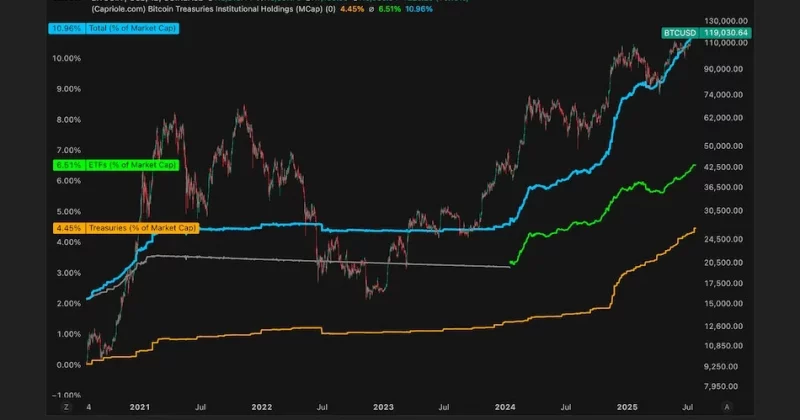
Institutional entities now control 18.5% of all Bitcoin. While ETFs face recent outflows, whale accumulation suggests a shift in long-term ownership.
Institutional entities currently hold approximately 3.88 million Bitcoin, representing 18.5% of the asset’s fixed 21 million supply cap [1]. This collective stack includes holdings from public companies, exchange-traded funds (ETFs), governments, and private firms [1].
Key takeaways
- As of May 28, 254 tracked entities held 3,902,128 Bitcoin, accounting for 18.58% of the total supply [1].
- Public companies and ETFs are the largest institutional pools, holding 5.9% and 6.3% of the supply, respectively [1].
- Governments maintain a significant presence, controlling approximately 650,000 Bitcoin, or 3.1% of the total supply [1].
- While spot ETFs experienced a six-day redemption streak totaling roughly $1.55 billion in mid-May, on-chain data shows whale entities holding 1,000+ Bitcoin reached a yearly high on May 22 [2].
Shifting Dynamics in Institutional Ownership
The landscape of institutional Bitcoin exposure is currently defined by a divergence between ETF activity and corporate balance sheet strategies. Public companies hold roughly 1.24 million Bitcoin, with Strategy remaining the dominant holder at 843,738 coins [1]. Despite reporting a $14.46 billion unrealized loss on its holdings in the first quarter of 2026, Strategy continues to pursue acquisition, with analysts forecasting the purchase of an additional 100,000 Bitcoin during the second quarter [2].
Conversely, the spot ETF complex has faced recent pressure. BlackRock’s iShares Bitcoin Trust (IBIT), which holds roughly 811,000 Bitcoin, saw significant redemptions during a six-day period ending May 22, contributing to a total of $1.55 billion in outflows across 11 U.S. spot ETFs [1, 2]. Market analysts attribute this institutional rotation to rising Treasury yields and shifting expectations regarding Federal Reserve interest rate cuts [2].
Whale Accumulation and Market Volatility
While institutional vehicles like ETFs have seen net outflows, on-chain data indicates that larger private holders are absorbing the supply. The number of whale entities holding at least 1,000 Bitcoin reached 1,282 on May 22, matching a peak set earlier in the month [2]. This activity suggests a transfer of coins from price-sensitive institutional funds to long-term-conviction balance sheets [2].
Simultaneously, the market has experienced a period of relative stillness, with the Bitcoin Volmex Implied Volatility Index falling to 36.11 in late May, its lowest point since September 2025 [3]. This decline in volatility is partly driven by institutional funds selling options to generate yield, a process that compresses implied volatility and often precedes significant price movements [3].
Why it matters
The current market environment reflects a structural tug-of-war between retail selling and institutional accumulation. While ETF redemptions have created mechanical sell pressure, the simultaneous increase in whale holdings suggests that large-scale investors are utilizing the current price range to consolidate positions [2]. As institutional allocators rotate capital in response to macroeconomic factors like inflation and bond yields, the market remains in a state of consolidation, with analysts noting that the outcome of this divergence between whale accumulation and retail exit will likely determine the direction of the next market cycle [2, 3].
Coming upLIVEsee all →
Across the coverage
Coverage is mostly measured — 105 of 116 reports stay neutral.
Bullish 4
Neutral 105
Bearish 7
The Catalyst Brief
Know what’s about to move the market.
Every Monday — the token unlocks, Fed dates & catalysts set to move crypto and markets this week. So you’re never blindsided.
Free · 3-min read · one-click unsubscribe
Synthesized from 3 sources
- 01Institutions now hold 18.5% of all Bitcoin that will ever exist
- 02Bitcoin’s $74K Floor Looks Stronger Than Its Weak Tape Suggests | Investing.comInvesting.com
- 03The Quiet Before the Breakout: Bitcoin Whales Are Accumulating While Retail...Investing.com
AI-assisted synthesis by the TrendWatcher Editorial Desk · sourced from 3 outlets · Jun 1, 2026 · How we report
Published
May 29, 2026, 04:20 PM
Author
Editorial Team
Source
TrendWatcher AI (Enhanced)
Frequently asked · Microstrategy Bitcoin
How many Bitcoin does MicroStrategy own?
MicroStrategy holds roughly 818,334 Bitcoin, representing a fair‑value unrealized loss of $14.46 billion as of Q1 2026.
What is the company’s debt situation?
The firm carries $8.17 billion in long‑term debt and raised $11.68 billion in equity year‑to‑date.
What are analysts’ price targets for the stock?
24/7 Wall St. analysts have price targets of $338.56 and $358.56, implying upside of roughly 260%–268% from the current price.
Why did MicroStrategy sell Bitcoin recently?
It sold 3,588 Bitcoin, worth about $225 million, to fund preferred stock dividend payments.
What risks are highlighted for the stock?
Key risks include Bitcoin price declines, high leverage, preferred dividend obligations, and potential MSCI index removal.