Loading article…
Recession
Indian Stock Markets Face Volatility Amid Monsoon and Global Tensions
TrendWatcher AI (Enhanced)·59d ago·neutral
Most covered nowLIVEsee all →
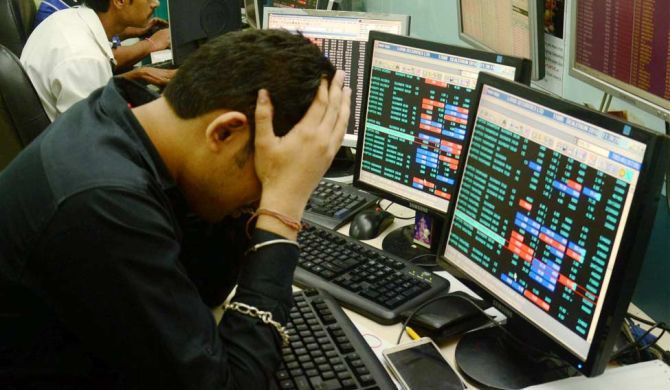
Indian equity markets face significant pressure as weak monsoon forecasts and Middle East geopolitical tensions trigger a multi-day sell-off for investors.
Indian benchmark indices have experienced a period of intense selling pressure, with the Sensex and Nifty recording significant losses over several consecutive trading sessions [2, 4]. Investor sentiment has been dampened by a combination of geopolitical instability in the Middle East and concerns regarding a potentially weak monsoon season in India [1, 3].
Key takeaways
- The Sensex saw a sharp decline of 1,092 points on May 29, contributing to a four-day loss of 2,220 points by June 1 [2, 4].
- The India Meteorological Department (IMD) projects monsoon rainfall at 90% of the long-period average, the lowest level in 11 years [1, 4].
- Geopolitical uncertainty, including the fragility of a Middle East ceasefire and recent military strikes, has driven up global crude oil prices [2, 4].
- Foreign Institutional Investors (FIIs) have continued to offload Indian equities, with net outflows reaching record levels for the year [2, 4].
- Market capitalization for BSE-listed companies fell by ₹4.26 lakh crore in a single day of trading on June 1 [4].
Impact of Weather and Geopolitical Instability
The primary driver of recent market anxiety is the India Meteorological Department's latest monsoon projection, which suggests rainfall will be only 90% of the long-period average [1, 2]. This forecast, which represents the weakest monsoon outlook in over a decade, has raised significant alarms regarding potential impacts on agricultural output and food inflation [1, 4]. Analysts note that the prospect of deficient rainfall, combined with the potential for an El Nino weather pattern, has caused investors to move away from sectors sensitive to rural demand, such as auto and consumer goods [2, 4].
Simultaneously, the escalation of conflict in the Middle East has created a "risk-off" environment for global investors [4]. Following reports of military strikes involving the United States and Iran, Brent crude futures saw a sharp increase, reaching near $94 per barrel [4]. The lack of formal confirmation regarding a lasting ceasefire in the region has kept institutional investors cautious, limiting their appetite for risk in emerging markets like India [2, 4].
Market Performance and Investor Outlook
The selling pressure has been broad-based, affecting various sectors including banking, realty, and chemicals [1, 3]. On June 1, the BSE-listed companies saw their total market capitalization drop to ₹460.70 lakh crore [4]. Despite the overall downward trend, certain sectors like IT have occasionally outperformed, showing resilience even as broader indices struggled [1, 2].
Analysts suggest that while the current environment is challenging, some downside risk has been partially mitigated by a recent moderation in bond yields [2]. Looking ahead, some market observers believe that the potential resumption of India-US trade negotiations could serve as a supportive trigger for future market sentiment [4]. For now, experts continue to advise investors to focus on fundamental asset allocation and remain patient as the market navigates these global and domestic uncertainties [1].
Why it matters
The current market volatility highlights the vulnerability of the Indian economy to external energy shocks and climate-dependent agricultural cycles. With inflation concerns rising due to higher energy costs and the threat of poor crop yields, the central bank and policymakers face a complex environment. The sustained outflow of foreign capital underscores a broader trend of global investors seeking stability, making the upcoming monsoon performance and the resolution of Middle East hostilities critical factors for the market's recovery trajectory.
Coming upLIVEsee all →
Across the coverage
Coverage is mostly measured — 24 of 30 reports stay neutral.
Bullish 3
Neutral 24
Bearish 3
The Catalyst Brief
Know what’s about to move the market.
Every Monday — the token unlocks, Fed dates & catalysts set to move crypto and markets this week. So you’re never blindsided.
Free · 3-min read · one-click unsubscribe
Synthesized from 4 sources
- 01Indian equity markets open lower amid geopolitical tensions, monsoon worries - Telangana Today
- 02Indian Stock Market Plunges: Sensex Down 1,092 Points on Monsoon Forecast, Geopolitical Concerns - Rediff.com Business
- 03ಮಧ್ಯಪ್ರಾಚ್ಯ ಬಿಕ್ಕಟ್ಟು, ದುರ್ಬಲ Monsoon ಆತಂಕ; Indian Stock Market ಭಾರಿ ಕುಸಿತ!ಕನ್ನಡ ಪ್ರಭ
- 04Sensex crashes 500 points, extends losing run to 4th day; what drove the Indian stock market lower? | Stock Market News
AI-assisted synthesis by the TrendWatcher Editorial Desk · sourced from 4 outlets · Jun 3, 2026 · How we report
Published
May 29, 2026, 12:00 AM
Source
TrendWatcher AI (Enhanced)
Frequently asked · Recession
What is Recession?
Recession is a trending topic in the news. Recent coverage of Recession includes: EWC: Canada In Technical Recession But Here's Why You Want To Buy (Upgrade) (NYSEARCA:EWC) - Seeking Alpha.
Why is Recession trending today?
10 news sources analyzed
What is the current sentiment on Recession?
Based on our analysis of recent news articles, Recession has mixed coverage. Check the sentiment score above for detailed analysis.
Where can I get the latest Recession news?
TrendWatcher aggregates Recession news from 100+ trusted sources and provides AI-powered sentiment analysis updated in real-time.