Loading article…
Bitcoin
Logistics Prices Surge 5.6 Points
TrendWatcher AI (Enhanced)·118d ago·bullish
Most covered nowLIVEsee all →
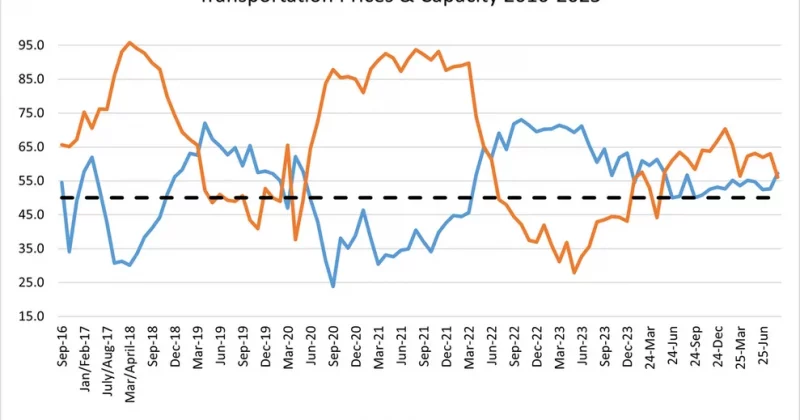
Logistics managers' index shows transportation prices hit second-highest level ever, with a 5.6 point surge in April, amid changing freight patterns and supply
Logistics managers' index transportation prices surged 5.6 points in April, hitting the second-highest level ever, as ground transportation demand remains linked to commerce, freight movement, and distribution activity [1]. This increase reflects the ongoing challenges in the transportation sector, where companies like Ryder and FedEx play a crucial role in connecting manufacturers, retailers, and consumers through extensive delivery networks. Ryder, a Russell 1000 Index member, operates across fleet management, transportation, and supply chain services, with a business model centered on vehicle leasing, rental services, maintenance programs, and logistics operations [1].
The recent surge in logistics prices can be attributed to the evolving position of companies like FedEx in the global logistics market. FedEx, also a Russell 1000 Index constituent, has built a broad transportation network that spans air cargo, ground delivery, freight movement, and supply chain services [2]. The company's separation of its freight business into an independent publicly traded entity has altered its corporate structure and created a distinct entity focused exclusively on freight transportation services [2]. This move enables clearer distinctions between business segments that previously operated under the same corporate umbrella.
The expansion of international infrastructure by companies like FedEx is also a significant factor in the logistics market. Recent announcements highlighted activity in the Netherlands, where transportation facilities are being expanded to support cargo operations and distribution efficiency [2]. This development is essential for modern logistics networks, allowing companies to consolidate shipments, coordinate transportation, and improve delivery times. As the transportation sector continues to support essential commercial activity through freight movement, vehicle services, and logistics management, companies like Ryder and FedEx remain focused on service reliability, asset utilization, logistics coordination, and network performance.
The surge in logistics prices and the changing landscape of the transportation sector have significant implications for companies and consumers alike. As the demand for shipping and fulfillment services continues to grow, driven by the increase in electronic commerce, logistics providers must adapt to expanding delivery capabilities and enhancing operational efficiency [2]. The real stake is whether companies like Ryder and FedEx can maintain their position in the market and continue to support the movement of goods across regional and national networks, amid changing freight patterns and supply chain demands.
Coming upLIVEsee all →
Across the coverage
Coverage is mostly measured — 286 of 300 reports stay neutral.
Bullish 5
Neutral 286
Bearish 9
The Catalyst Brief
Know what’s about to move the market.
Every Monday — the token unlocks, Fed dates & catalysts set to move crypto and markets this week. So you’re never blindsided.
Free · 3-min read · one-click unsubscribe
Synthesized from 2 sources
- 01Why Is Russell 1000 Transportation Member Ryder Gaining Attention?Kalkine Media
- 02Why Is Russell 1000 Logistics Focus Shifting After FedEx Freight Split?Kalkine Media
AI-assisted synthesis by the TrendWatcher Editorial Desk · sourced from 2 outlets · Jun 15, 2026 · How we report
Published
May 17, 2026, 09:41 PM
Author
Editorial Team
Source
TrendWatcher AI (Enhanced)
Frequently asked · Bitcoin
Why is the price of Bitcoin dropping as of September 2026?
Bitcoin is dropping due to hot core inflation data, a high probability of a Federal Reserve rate hike, and four consecutive days of net outflows from U.S. spot Bitcoin ETFs as of September 11, 2026. Additionally, long-term holders have been selling into the $77,000 to $80,000 price range, creating a supply wall that limits upward movement.
What is the significance of the $82,000 level for Bitcoin?
The $82,000 level serves as a key resistance zone for Bitcoin because sellers have repeatedly pushed the price lower from this area, including a peak of $82,283 on September 3, 2026. Analysts and AI models indicate that Bitcoin must break and hold above this level, supported by strong ETF inflows, to confirm a more bullish trend.
How do ETF flows affect the price of Bitcoin?
Bitcoin spot ETF flows impact price because when ETFs redeem shares, authorized participants sell Bitcoin to fund those redemptions, resulting in direct spot selling. Conversely, strong inflows act as a source of passive buying that absorbs supply and can help Bitcoin break through resistance levels.
What is a golden cross in the context of Bitcoin?
A golden cross occurs when the 50-day moving average of Bitcoin rises above the 200-day moving average, which is generally viewed by market analysts as a bullish signal. Bitcoin formed its first golden cross since May 2025 following a recovery from its July 2026 lows.