Loading article…
Ethereum
US April budget surplus falls to $215 billion, below forecasts
TrendWatcher AI (Enhanced)·123d ago·bearish
Most covered nowLIVEsee all →
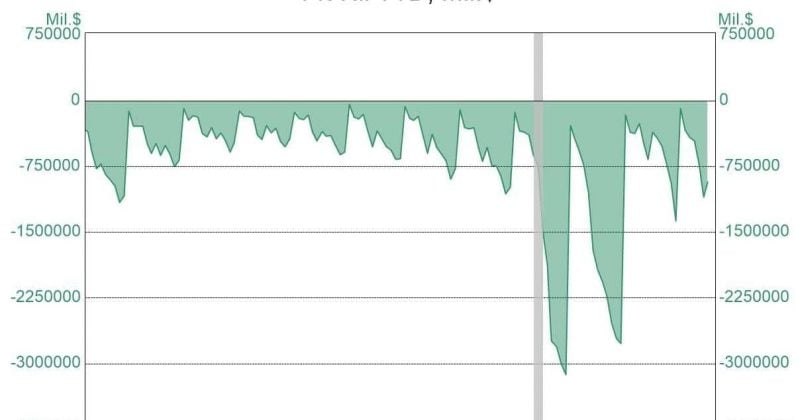
US April budget surplus hits $215 billion, missing the $220 billion forecast and down 16.7% from a year ago, with higher spending and modest tariff gains.
The Treasury reported a $215 billion surplus for April, shy of the $220 billion analysts expected and 16.7% lower than the $258 billion surplus recorded in the same month a year earlier [1]. The shortfall stems from a squeeze between receipts and outlays: revenues fell to $837 billion, $13 billion less than April 2025, while spending rose to $622 billion, $30 billion more than a year prior [1].
Higher outlays are driven by rising interest payments on the national debt, increased defense spending, and growing entitlement costs. The Congressional Budget Office notes that net interest expense has climbed to $628 billion year‑to‑date, up $41 billion (7%) from the previous year, and now exceeds annual Medicare and Medicaid spending, trailing only Social Security among major expenditures [2]. Meanwhile, a boost in customs duties added $22.12 billion in April, cushioning what could have been a deeper revenue decline [1].
Despite the monthly miss, the fiscal‑year‑to‑date deficit stands at $954 billion, about $95 billion better than the same point in FY 2025, suggesting that tariff inflows and some spending restraint are beginning to dent the overall deficit picture [1]. However, the sustainability of this modest improvement is uncertain. The Treasury’s customs revenue surge relies heavily on tariffs that face legal challenges; roughly $166 billion of recent tariff collections may need to be refunded after a Supreme Court ruling, casting a shadow over the headline numbers [1].
The broader fiscal backdrop remains stark. Interest costs now outpace key social programs, and defense outlays continue to rise amid the ongoing Iran conflict, where Pentagon estimates place direct U.S. military spending at about $29 billion so far this year [2]. As debt service consumes a larger share of the budget, any further escalation in interest rates or defense spending could erode future surpluses.
The key question for policymakers is whether the modest YTD deficit improvement can be sustained without relying on volatile tariff revenues, especially as legal and economic headwinds loom. The trajectory of interest costs and defense outlays will likely dictate whether the U.S. can return to a solid surplus later in the fiscal year.
Coming upLIVEsee all →
Across the coverage
Coverage is mostly measured — 283 of 300 reports stay neutral.
Bullish 10
Neutral 283
Bearish 7
The Catalyst Brief
Know what’s about to move the market.
Every Monday — the token unlocks, Fed dates & catalysts set to move crypto and markets this week. So you’re never blindsided.
Free · 3-min read · one-click unsubscribe
Synthesized from 2 sources
- 01The federal budget surplus for April $215 billion which is less than the $220 billion est. | investingLiveInvestinglive
- 02The federal budget surplus for April $215 billion which is less than the $220 billion est. — TradingView NewsTradingview
AI-assisted synthesis by the TrendWatcher Editorial Desk · sourced from 2 outlets · Jun 16, 2026 · How we report
Published
May 15, 2026, 02:14 PM
Author
Editorial Team
Source
TrendWatcher AI (Enhanced)
Frequently asked · Ethereum
How much Ethereum does Bitmine Immersion Technologies own?
Bitmine Immersion Technologies held 5,956,378 Ethereum tokens as of late August 2026. These holdings are valued at approximately $14.89 billion.
What percentage of the total Ethereum supply does Bitmine hold?
Bitmine Immersion Technologies holds approximately 4.9% of the total Ethereum supply as of late August 2026. The company is approaching a stated goal of owning 5% of the total supply.
Is Bitmine staking its Ethereum holdings?
Yes, approximately 85% of the Ethereum held by Bitmine Immersion Technologies is currently staked. This staking activity is projected to generate $334 million in annualized revenue for the company.
How has Ethereum performed compared to other assets in 2026?
Ethereum is described as the best-performing macro asset during the third quarter of 2026, according to statements from Bitmine Chairman Tom Lee. As of late August 2026, Ethereum outperformed the S&P 500 by 5,866 basis points.