Loading article…
Arbitrum
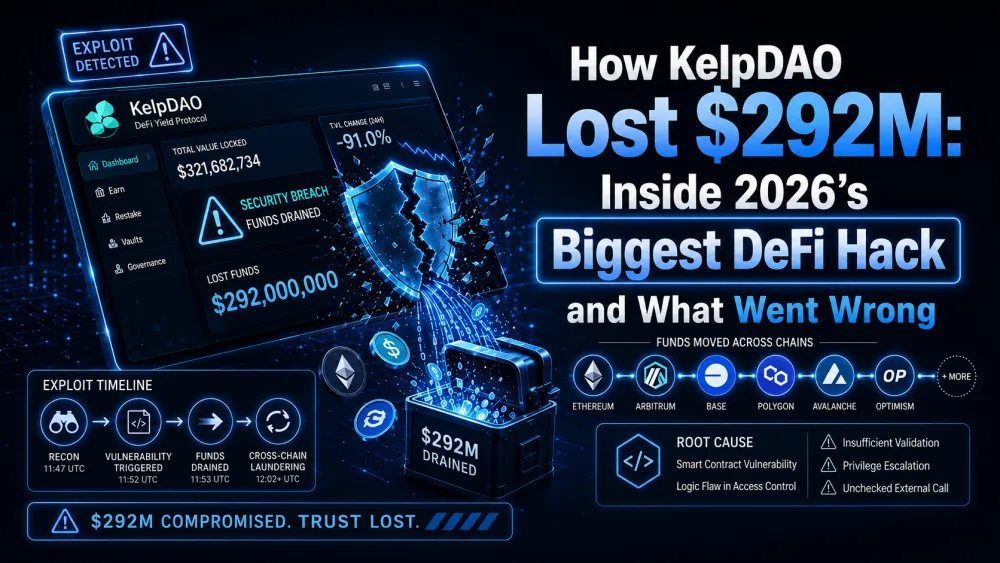
KelpDAO Loses $292M in 2026 DeFi Bridge Hack
TrendWatcher AI (Enhanced)·107d ago·bearish
Most covered nowLIVEsee all →
A $292 million exploit on KelpDAO using a compromised LayerZero bridge triggered a liquidity crisis, draining billions from DeFi protocols like Aave.
In April 2026, liquid restaking protocol KelpDAO suffered the largest decentralized finance (DeFi) exploit of the year, losing approximately $292 million in a sophisticated attack on its cross-chain bridge [1]. The incident, attributed by LayerZero to the North Korean-linked TraderTraitor subgroup, involved compromising remote procedure call (RPC) nodes to trick a single verifier into releasing 116,500 rsETH tokens [1][2]. This theft triggered a broader liquidity crisis, resulting in billions of dollars in withdrawals across the DeFi ecosystem [1].
Key takeaways
- KelpDAO lost $292 million after an attacker exploited a single-verifier configuration on its LayerZero bridge [1].
- The attacker used compromised RPC nodes and a DDoS attack to forge data and bypass security checks [1].
- Depositing stolen rsETH as collateral on Aave allowed the attacker to borrow roughly $236 million in other assets [2].
- The exploit caused a bank run, with over $13 billion withdrawn from DeFi protocols within 48 hours [1].
Bridge Configuration and Node Manipulation
KelpDAO utilized a bridge built on LayerZero’s messaging infrastructure to move its rsETH token between networks, a setup that relied on a single verifier to confirm cross-chain transfer instructions [1]. On April 18, attackers compromised two RPC nodes—the servers that relay blockchain data to the verifier—and fed them forged data while accurately reporting to other monitoring systems [1]. A simultaneous distributed denial-of-service (DDoS) attack forced the verifier to fail over to the poisoned nodes, leading the system to approve a fraudulent instruction that released 116,500 rsETH to an attacker-controlled address [1]. Following the breach, a dispute arose regarding liability, with LayerZero blaming KelpDAO’s single-verifier configuration, while KelpDAO countered that this was the default setup used by roughly 40% of protocols on the network [1].
Cascading Losses and Market Panic
After obtaining
Coming upLIVEsee all →
Across the coverage
Coverage is mostly measured — 24 of 29 reports stay neutral.
Bullish 1
Neutral 24
Bearish 4
The Catalyst Brief
Know what’s about to move the market.
Every Monday — the token unlocks, Fed dates & catalysts set to move crypto and markets this week. So you’re never blindsided.
Free · 3-min read · one-click unsubscribe
Synthesized from 2 sources
- 01The KelpDAO $292M crypto hack: What IT execs must know | TechTargetTechtarget
- 02KelpDAO/LayerZero Hack: $290m Exploit Exposes DeFi’s Hidden Risks | GalaxyGalaxy
AI-assisted synthesis by the TrendWatcher Editorial Desk · sourced from 2 outlets · Jun 3, 2026 · How we report
Published
May 28, 2026, 11:06 AM
Author
Yuri Molchan
Source
TrendWatcher AI (Enhanced)
Frequently asked · Arbitrum
What is the primary purpose of the Arbitrum blockchain?
Arbitrum is designed to scale the Ethereum network by handling transactions off-chain, which increases speed and reduces transaction fees for users.
How is LG Electronics using Arbitrum technology?
LG Electronics has developed a custom layer-2 blockchain with Arbitrum to automate the placement, buying, and management of digital advertisements.
What is the role of the ARB token?
The ARB token is a governance token that allows holders to vote on decisions regarding the future development of the Arbitrum protocol.
Does Arbitrum process transactions on the Ethereum mainnet?
No, Arbitrum uses rollups to process transactions off the main Ethereum chain while still utilizing Ethereum's security features.