Loading article…
Crypto Payments
Circle Launches Arc Blockchain for Agentic Economy
TrendWatcher AI (Enhanced)·59d ago·neutral
Most covered nowLIVEsee all →
Circle has introduced Arc, a Layer-1 blockchain designed as an Economic OS to provide real-time payment rails for autonomous AI agents and enterprises.
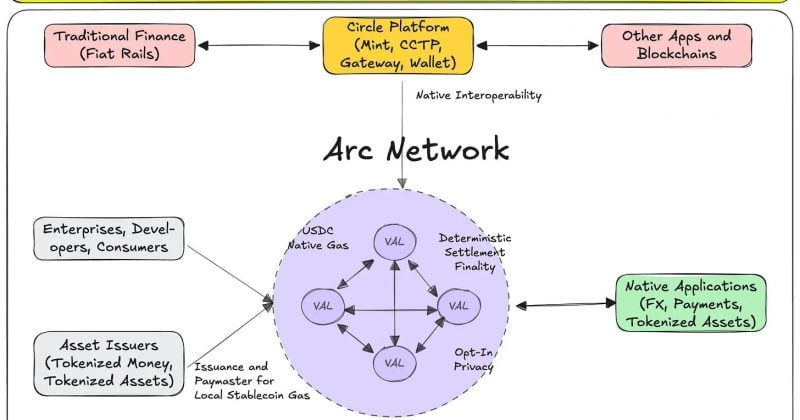
Circle has introduced Arc, an enterprise-grade Layer-1 blockchain designed to function as an "Economic OS for the internet" [1]. The platform aims to provide the programmable, real-time financial infrastructure necessary for an emerging "agentic economy," where autonomous AI agents and machines can conduct transactions without human intervention [2].
Key takeaways
- Arc is engineered for enterprise use, featuring stablecoin-based gas fees, sub-second finality, and opt-in configurable privacy [1].
- The project seeks to support machine-to-machine commerce, allowing IoT devices and AI agents to manage their own financial autonomy [1].
- Circle Ventures has launched the Arc Builders Fund to provide capital and support to early-stage teams developing applications on the network [1].
- A public testnet for Arc launched on October 28, 2025, drawing participation from over 100 companies [2].
- Reports indicate a $222 million presale for the native ARC token was completed on May 11, 2026, at a $3 billion fully diluted valuation [2].
Infrastructure for an Autonomous Economy
The core design of Arc prioritizes predictable costs and high-speed performance to accommodate machine-driven activity. By denominating gas fees in stablecoins like USDC rather than volatile native tokens, the network aims to eliminate the uncertainty of transaction costs [2]. The platform utilizes what Circle describes as "Nanopayments," which can reduce transaction fees to as low as $0.000001, a cost structure intended to make high-frequency, low-value machine transactions economically viable [2].
To accelerate the development of this ecosystem, Circle Ventures introduced the Arc Builders Fund. This initiative provides funding, hands-on support, and access to an investor network for companies building on the platform [1]. The fund is targeting specific high-impact verticals, including perpetuals markets, credit protocols, onchain foreign exchange, and energy and compute markets [1]. While Circle Ventures has engaged a network of top-tier investors to review submissions, the company clarifies that this is an internal initiative and not a formal investment fund [1].
Why it matters
Arc represents a strategic shift for Circle, moving beyond its role as a stablecoin issuer to become a provider of core blockchain infrastructure [2]. By creating a specialized environment for AI agents and enterprise applications, the project attempts to solve the friction currently faced by autonomous software operating on financial rails designed for human speed and cost [1]. While the ARC token is expected to support governance and a future proof-of-stake mechanism, specific details regarding its utility remain undefined [2]. As the network develops, its success will depend on its ability to attract builders who require deterministic finality and enterprise-grade rails for real-world economic activity [1].
Coming upLIVEsee all →
Across the coverage
Coverage is mostly measured — 126 of 132 reports stay neutral.
Bullish 6
Neutral 126
The Catalyst Brief
Know what’s about to move the market.
Every Monday — the token unlocks, Fed dates & catalysts set to move crypto and markets this week. So you’re never blindsided.
Free · 3-min read · one-click unsubscribe
Synthesized from 2 sources
- 01Introducing the Arc Builders Fund
- 02Circle launches Arc blockchain to power the agentic economy with programmable real-time railsCrypto Briefing
AI-assisted synthesis by the TrendWatcher Editorial Desk · sourced from 2 outlets · Jun 1, 2026 · How we report
Published
May 29, 2026, 07:29 PM
Author
Editorial Team
Source
TrendWatcher AI (Enhanced)
Frequently asked · Crypto Payments
When will Sberbank's crypto services become available?
Sberbank plans to debut its Bitcoin and crypto wallet and digital asset custody service by December, according to Interfax.
What is the purpose of NectarPay's platform?
NectarPay enables merchants to accept Bitcoin, TEXITcoin, USDC and other digital currencies with zero fees, non‑custodial settlement, and sub‑second processing.
How does Coinbase view the relationship between crypto and AI?
Coinbase CEO Brian Armstrong asserts that crypto provides the financial rails needed for AI agents, describing the two as complementary technologies.
Are there any restrictions on crypto use in Russia?
Crypto use as a payment method has been illegal in Russia since 2022, though it is allowed for international settlements under recent legislation.
What advantages does NectarPay claim over traditional card processing?
NectarPay claims zero transaction fees, no chargeback exposure, and settlement times under a second, compared with typical card fees of about 2.9% plus 30 cents and settlement periods of two to seven days.