Loading article…
Bitcoin
Japan Government Bond Yields Hit Multi-Decade Highs
TrendWatcher AI (Enhanced)·118d ago·bullish
Most covered nowLIVEsee all →
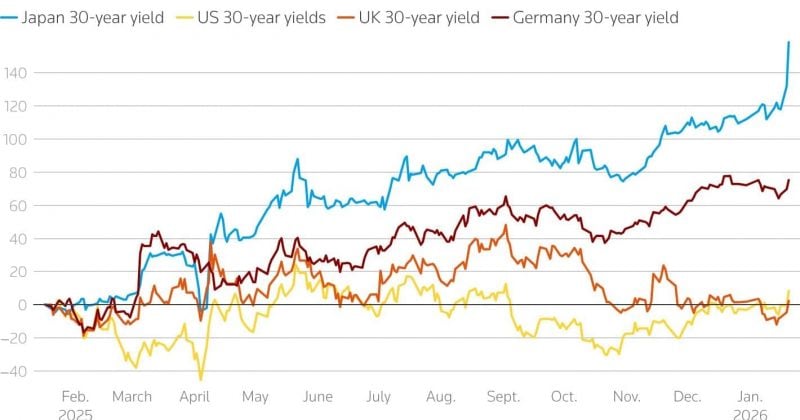
Japan government bond yields are surging to levels not seen since 1999, threatening to trigger a global capital repatriation that could roil U.S. markets.
Japan’s government bond market is experiencing a sharp selloff that has pushed the 30-year yield to approximately 4%, a level not seen since the instrument was launched in 1999 [1]. The 40-year yield has surged to around 4.24%, while the 10-year yield climbed to roughly 2.38%, marking its highest point in decades [3].
The shift follows the Bank of Japan’s decision to scale back its bond purchases, moving away from a previous policy that capped the 10-year yield at 0.5% [1]. With Japan’s debt-to-GDP ratio sitting at approximately 230%, the rising cost of borrowing is creating significant pressure on the nation’s fiscal math [3]. The selloff has been exacerbated by a demand-supply mismatch, as Japanese life insurance companies—historically key buyers of long-dated bonds—have largely met their regulatory requirements, leaving a void that private investors have yet to fill [4].
As the world’s largest net foreign creditor, Japan holds roughly $5 trillion in overseas assets [1]. For decades, Japanese institutional investors have funneled capital into U.S. Treasuries and European sovereign debt to chase higher returns. Now, with domestic yields becoming more attractive, analysts warn of a potential "carry trade" unwind. If institutions like the $1.8 trillion Government Pension Investment Fund shift even a portion of their foreign holdings back to Japan, it could force U.S. and European yields higher [3].
This potential repatriation of capital poses a direct threat to risk assets, including crypto, which historically struggles when global liquidity contracts [1]. Strategists suggest that the strengthening yen and rising Japanese yields could force traders to close short-yen positions, potentially repeating the market volatility seen last August [4]. Some experts, such as Societe Generale’s Albert Edwards, have gone as far as to warn that a continued climb in Japanese yields could trigger a "global financial market Armageddon" by tightening financial conditions and reducing world growth [4].
The central question remains whether this shift is a manageable adjustment or the start of a broader exodus from U.S. assets. If Japanese investors decide that the era of "U.S. exceptionalism" is ending, the resulting capital flight could fundamentally alter the Federal Reserve’s policy calculus and the stability of global markets [4].
Coming upLIVEsee all →
Across the coverage
Coverage is mostly measured — 286 of 300 reports stay neutral.
Bullish 5
Neutral 286
Bearish 9
The Catalyst Brief
Know what’s about to move the market.
Every Monday — the token unlocks, Fed dates & catalysts set to move crypto and markets this week. So you’re never blindsided.
Free · 3-min read · one-click unsubscribe
Synthesized from 4 sources
- 01Japan government bonds slide as yields rise amid global selloffCrypto Briefing
- 02Japan government bonds slide as yields rise amid global selloffNewsbreak
- 03Japan government bonds slide as yields rise amid global selloffGlobalfinancesdaily
- 04Japan government bonds: high yields spark fears of carry trade ... - CNBCCNBC
AI-assisted synthesis by the TrendWatcher Editorial Desk · sourced from 4 outlets · Jun 15, 2026 · How we report
Published
May 18, 2026, 12:51 AM
Author
Editorial Team
Source
TrendWatcher AI (Enhanced)
Frequently asked · Bitcoin
Why is the price of Bitcoin dropping as of September 2026?
Bitcoin is dropping due to hot core inflation data, a high probability of a Federal Reserve rate hike, and four consecutive days of net outflows from U.S. spot Bitcoin ETFs as of September 11, 2026. Additionally, long-term holders have been selling into the $77,000 to $80,000 price range, creating a supply wall that limits upward movement.
What is the significance of the $82,000 level for Bitcoin?
The $82,000 level serves as a key resistance zone for Bitcoin because sellers have repeatedly pushed the price lower from this area, including a peak of $82,283 on September 3, 2026. Analysts and AI models indicate that Bitcoin must break and hold above this level, supported by strong ETF inflows, to confirm a more bullish trend.
How do ETF flows affect the price of Bitcoin?
Bitcoin spot ETF flows impact price because when ETFs redeem shares, authorized participants sell Bitcoin to fund those redemptions, resulting in direct spot selling. Conversely, strong inflows act as a source of passive buying that absorbs supply and can help Bitcoin break through resistance levels.
What is a golden cross in the context of Bitcoin?
A golden cross occurs when the 50-day moving average of Bitcoin rises above the 200-day moving average, which is generally viewed by market analysts as a bullish signal. Bitcoin formed its first golden cross since May 2025 following a recovery from its July 2026 lows.