Loading article…
Web3
Mastercard Secures New York BitLicense for Stablecoin Strategy
TrendWatcher AI (Enhanced)·59d ago·neutral
Most covered nowLIVEsee all →
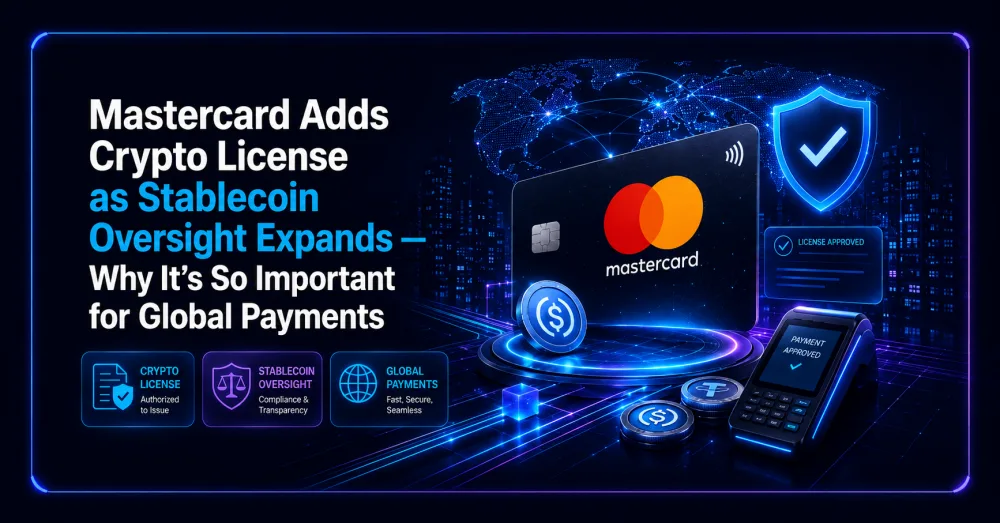
Mastercard has obtained a New York BitLicense to advance its blockchain-based payment and settlement infrastructure, focusing on stablecoins and deposits.
Mastercard has secured a New York BitLicense, granting the payments giant authorization to conduct digital asset activities under one of the most stringent regulatory frameworks in the United States [1]. The approval, granted to Mastercard Transaction Services (U.S.) LLC, marks a significant step in the company’s efforts to integrate blockchain-based settlement infrastructure into its existing global payments network [1].
Key takeaways
- The New York State Department of Financial Services (NYDFS) issued the BitLicense, which mandates strict compliance regarding cybersecurity, capital reserves, and consumer protection [1].
- Mastercard intends to use the license to support its development of tokenized deposits and stablecoin-based payment solutions [1].
- This move follows Mastercard’s agreement to acquire stablecoin payments firm BVNK for $1.8 billion in March [1].
- The BitLicense framework, established in 2015, has been granted to only about two dozen firms over the last decade [1].
Advancing Blockchain-Based Financial Infrastructure
The acquisition of the BitLicense is part of a broader strategy by Mastercard to position itself within a financial landscape where blockchain rails operate alongside traditional banking systems [1]. By obtaining this regulatory approval, the company aims to leverage stablecoins—digital tokens pegged to fiat currencies like the U.S. dollar—to facilitate faster, around-the-clock cross-border payments and business-to-business settlements [1].
Jorn Lambert, Mastercard’s chief product officer, stated that clear regulatory frameworks are essential for building trust as digital value transitions from experimental phases to practical, real-world applications [1]. While the BitLicense regime is often criticized by some industry participants for its high compliance costs and lengthy application timelines, supporters maintain that it provides necessary clarity for institutions operating in the digital asset space [1]. Mastercard joins a limited group of recent recipients, including Galaxy and Strike, as it seeks to maintain the same operational and compliance standards for its blockchain initiatives as it does for its traditional payment network [1].
Why it matters
The move underscores a growing trend among major financial institutions to treat stablecoins as a core component of mainstream financial infrastructure rather than a niche crypto product [1]. As traditional and digital financial systems continue to evolve, Mastercard’s focus on interoperability and reliability suggests a long-term bet that blockchain technology can effectively lower costs and increase the speed of global money movement [1]. By securing this license, the company is positioning itself to navigate the complex regulatory environment required to bridge the gap between legacy banking and decentralized digital assets [1].
Coming upLIVEsee all →
Across the coverage
Coverage is mostly measured — 24 of 32 reports stay neutral.
Bullish 3
Neutral 24
Bearish 5
The Catalyst Brief
Know what’s about to move the market.
Every Monday — the token unlocks, Fed dates & catalysts set to move crypto and markets this week. So you’re never blindsided.
Free · 3-min read · one-click unsubscribe
Synthesized from 3 sources
- 01Mastercard secures New York BitLicense to support stablecoin and digital payment infrastructureCoinDesk
- 02Crypto Biz: Crypto infrastructure spending rises as ETF appetite coolsCointelegraph
- 03Mastercard Expands Stablecoin Strategy With NY BitLicenseCoinlaw
AI-assisted synthesis by the TrendWatcher Editorial Desk · sourced from 3 outlets · Jun 2, 2026 · How we report
Published
May 29, 2026, 05:42 PM
Author
Yuri Molchan
Source
TrendWatcher AI (Enhanced)
Frequently asked · Web3
What is Web3?
Web3 is a trending topic in the news. Recent coverage of Web3 includes: Onxbit Expands ONX Web3 Trading Infrastructure, Connecting Crypto Markets with Global Digital Asset Opportunities - Macau Business.
Why is Web3 trending today?
10 news sources analyzed
What is the current sentiment on Web3?
Based on our analysis of recent news articles, Web3 has mixed coverage. Check the sentiment score above for detailed analysis.
Where can I get the latest Web3 news?
TrendWatcher aggregates Web3 news from 100+ trusted sources and provides AI-powered sentiment analysis updated in real-time.