Loading article…
Ethereum
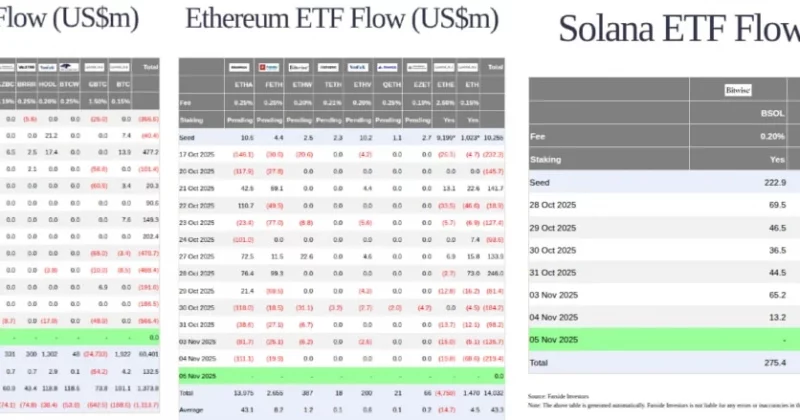
Ethereum ETFs lose $104M while Solana ETFs pull in $1.1B
TrendWatcher AI (Enhanced)·68d ago·neutral
Most covered nowLIVEsee all →
Ethereum spot ETFs saw a $104 million outflow on May 7, whereas Solana ETFs recorded an 11‑day inflow streak totaling $1.12 billion, highlighting a sharp
Ethereum spot exchange‑traded funds recorded a net outflow of $104 million on May 7, the day Solana‑linked ETFs extended an 11‑day streak of inflows that now totals $1.12 billion [1]. The contrast is stark: Ethereum’s cash flows have bounced between modest inflows and redemptions for months, never building sustained momentum, while Solana products have added roughly $100 million every day for nearly two weeks without a single negative day.
Daily swings of $50 million to $150 million are routine for Bitcoin and Ethereum ETFs, so the $104 million drop alone is not catastrophic. What matters is the emerging pattern—allocators are no longer treating crypto as a monolithic asset class but are cherry‑picking Layer 1 networks based on individual merits [1]. Bitcoin and Ethereum ETFs have historically shown mixed flows, but Solana’s consistent inflows suggest a deliberate portfolio construction rather than speculative trading. The speed of Solana’s accumulation is notable: Bitcoin ETFs took months to reach a cumulative $1 billion in inflows after launch, whereas Solana products compressed a similar milestone into less than two weeks [1].
Analysts attribute the rotation to a maturing market where institutional investors evaluate each token’s risk profile, narrative, and fundamentals separately. Solana’s appeal lies in its high‑throughput capabilities, low fees, and growing DeFi and consumer‑facing applications, which have attracted a developer ecosystem that rivals Ethereum in certain verticals [1]. Ethereum, despite its proof‑of‑stake transition, faces a “narrative problem” as fee revenue on the base layer declines and Layer 2 solutions fragment the ecosystem, making the investment case harder to pitch in a single slide [1].
The divergence also signals the possible end of the “rising tide lifts all boats” phase of the current crypto cycle for institutional capital. Money is moving out of Ethereum products and into Solana at a pace that would have been unthinkable a year ago, creating a self‑reinforcing flywheel where ETF inflows boost spot buying, support price, and attract further inflows [1]. However, the same mechanism could reverse quickly if a single negative flow day appears, or if Ethereum’s narrative is revived by a major upgrade or regulatory clarity.
For now, the data is clear: institutional money is exiting Ethereum ETFs while pouring into Solana ETFs, reshaping the crypto ETF landscape into a true multi‑asset market where each token must earn its allocation on fundamentals, narrative, and momentum. The next inflection point will be whether Solana’s inflow streak can hold or if a shift in sentiment redirects capital back to Ethereum.
Coming upLIVEsee all →
Across the coverage
Coverage is mostly measured — 217 of 262 reports stay neutral.
Bullish 24
Neutral 217
Bearish 21
The Catalyst Brief
Know what’s about to move the market.
Every Monday — the token unlocks, Fed dates & catalysts set to move crypto and markets this week. So you’re never blindsided.
Free · 3-min read · one-click unsubscribe
Synthesized from 3 sources
- 01Ethereum ETFs see $104M outflows while Solana ETFs quietly vacuum up $1.1B
- 02Bitcoin & Ethereum ETFs Shed Over $1B – But Solana and XRP See Inflows
- 03Bitcoin, Ether, And XRP ETFs Post Outflows While Solana Funds Quietly Flex Gains ⋆ ZyCrypto
AI-assisted synthesis by the TrendWatcher Editorial Desk · sourced from 3 outlets · Jun 13, 2026 · How we report
Published
May 21, 2026, 03:52 PM
Author
Editorial Team
Source
TrendWatcher AI (Enhanced)
Frequently asked · Ethereum
What is Ethereum’s primary purpose beyond being a digital currency?
Ethereum is a decentralized computing platform that enables developers to build and run applications and smart contracts without centralized oversight.
How did Ethereum’s consensus mechanism change in 2022?
In 2022 Ethereum switched from proof‑of‑work mining to a proof‑of‑stake system, allowing users to lock up ETH to help validate transactions and earn rewards.
What recent price movement has Ethereum experienced?
As of early July 2026, Ethereum’s price rose $84.99 from the previous day to $1,969.46, after earlier peaks of nearly $5,000 in August 2025.
What are some factors that influence Ethereum’s price?
Factors include investor speculation, network usage and DeFi adoption, broader economic conditions, regulatory developments, and competition from other smart‑contract blockchains.
What bullish price target do some forecasts suggest for Ethereum?
Some predictions, such as those from CoinDCX, envision Ethereum reaching $10,000 if current inflows and price trends continue.