Loading article…
Banking
Trump Reviews Iran Deal Amid New Oil Sanctions
TrendWatcher AI (Enhanced)·59d ago·neutral
Most covered nowLIVEsee all →
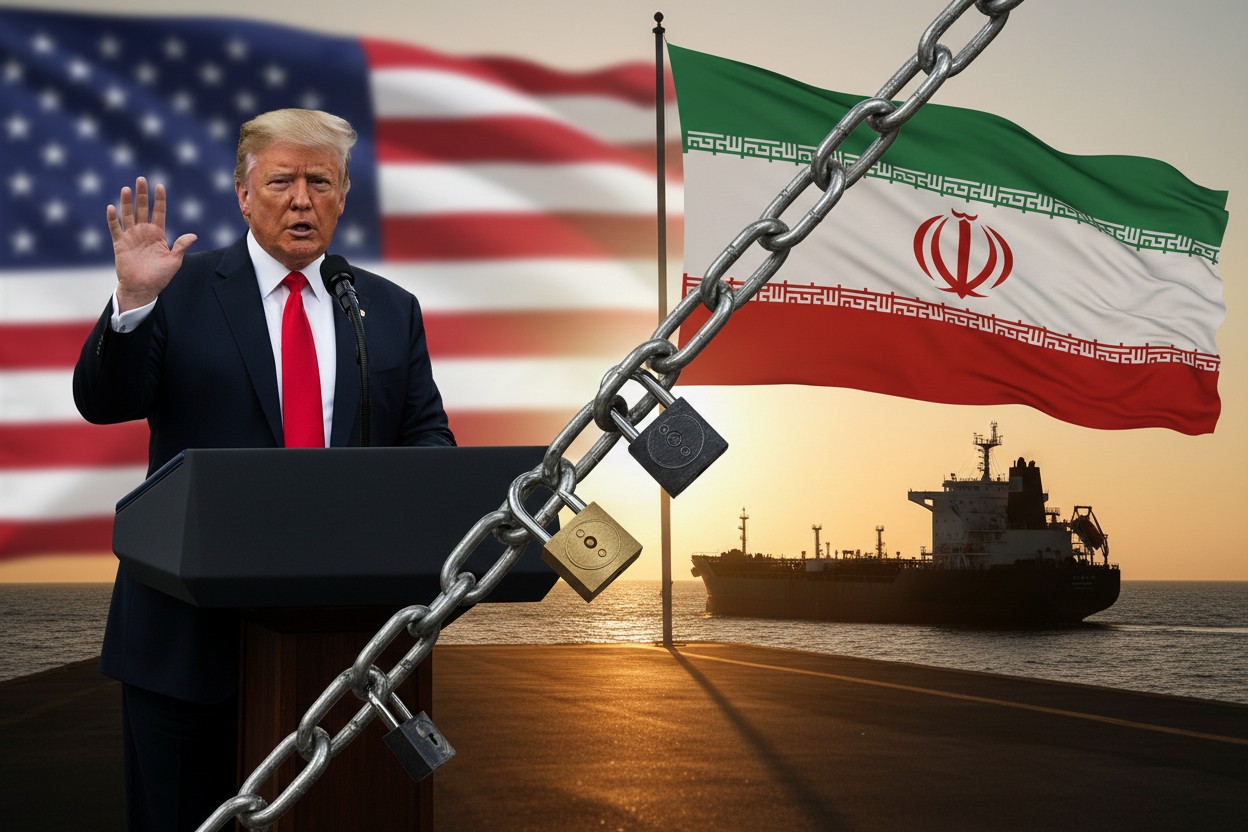
President Donald Trump is reviewing a potential deal with Iran to end the war, even as the U.S. imposes new sanctions on the country’s oil trade.
President Donald Trump is currently reviewing the latest draft of a potential agreement with Iran, though he has not yet signed off on the proposal [1]. Despite ongoing negotiations aimed at ending the war in the Middle East, the U.S. State Department and Treasury Department recently announced new sanctions targeting Iran’s oil trade [1].
Key takeaways
- President Trump has not yet finalized or signed the proposed agreement with Iran [1].
- The U.S. government recently imposed new sanctions on Iran’s oil sector despite active peace negotiations [1].
- The proposed deal focuses on extending a ceasefire and reopening the Strait of Hormuz but does not address Iran’s nuclear program [1].
- Global oil prices and European markets have fluctuated based on investor expectations regarding the potential deal [1].
Status of the Proposed Agreement
The potential deal, which has undergone revisions in recent days, aims to secure an extension of the Middle East ceasefire and restore shipping through the Strait of Hormuz [1]. This maritime route is critical to global energy markets, as approximately 20% of the world's oil passes through it [1]. While semiofficial Iranian media reported that the text of the agreement has seen changes, the deal remains unfinalized [1].
The negotiations occur against a backdrop of continued regional volatility. The U.S. and Iran have recently traded attacks, which initially raised concerns about a return to full-scale fighting [1]. Furthermore, the current framework under discussion does not include provisions regarding Iran’s nuclear program, focusing instead on immediate conflict de-escalation and trade stability [1].
Market Reactions and Regional Context
Investors have closely monitored the talks, with European shares rising on the prospect of a finalized agreement [1]. Global oil prices have also been impacted by the diplomatic developments; Brent crude fell to approximately $92 a barrel, marking a decline of nearly 20% throughout May as signs of a potential deal emerged [1].
The broader Middle East conflict continues to see significant activity, including ongoing Israeli military operations in Gaza and Lebanon [1]. While the U.S. seeks a path toward ending the war, the administration’s decision to implement new sanctions simultaneously highlights the complex and often contradictory nature of the current diplomatic efforts [1].
Why it matters
The potential deal represents a significant effort to stabilize energy markets and halt the war that has consumed the region for three months [1]. However, the lack of a final signature from President Trump, combined with the imposition of new sanctions, suggests that the path to a lasting resolution remains uncertain [1]. The outcome of these negotiations will likely determine the future of shipping through the Strait of Hormuz and the trajectory of energy prices, which have remained volatile throughout the conflict [1].
Coming upLIVEsee all →
Across the coverage
Coverage is mostly measured — 165 of 186 reports stay neutral.
Bullish 12
Neutral 165
Bearish 9
The Catalyst Brief
Know what’s about to move the market.
Every Monday — the token unlocks, Fed dates & catalysts set to move crypto and markets this week. So you’re never blindsided.
Free · 3-min read · one-click unsubscribe
Synthesized from 3 sources
- 01Trump reviews possible Iran deal as U.S. imposes new sanctionsNBC News
- 02Trump: We’re not satisfied with Iran dealThe Telegraph
- 03Trump eyes Iran deal with many of the trade-offs he blasted Obama for acceptingThe Washington Post
AI-assisted synthesis by the TrendWatcher Editorial Desk · sourced from 3 outlets · Jun 1, 2026 · How we report
Published
May 30, 2026, 06:00 AM
Author
Garrison Vance
Source
TrendWatcher AI (Enhanced)
Frequently asked · Banking
Which banks reported issues with transfers on July 27?
Barclays, Halifax, Lloyds, Revolut, and Monzo were among the banks reporting transfer or payment problems.
What did Downdetector report about the number of issues?
Downdetector logged 348 reports for Barclays, 269 for Lloyds, and 169 for Halifax.
Did any banks indicate that their app services were unaffected?
Barclays noted that its app continued to operate normally despite online banking issues.
How did Lloyds respond to the Faster Payments issue?
Lloyds posted on X that it was investigating the Faster Payments issue and was aware of customer delays.
Were there any scheduled maintenance notices for the affected services?
Lloyds' service status page showed no scheduled maintenance despite the reported issues.