Loading article…
Bitcoin
US and Iran Reach Agreement to End Months-Long War
TrendWatcher AI (Enhanced)·118d ago·bearish
Most covered nowLIVEsee all →
The US and Iran have finalized a memorandum of understanding to end their four-month war, reopening the Strait of Hormuz and initiating a 60-day cease-fire.
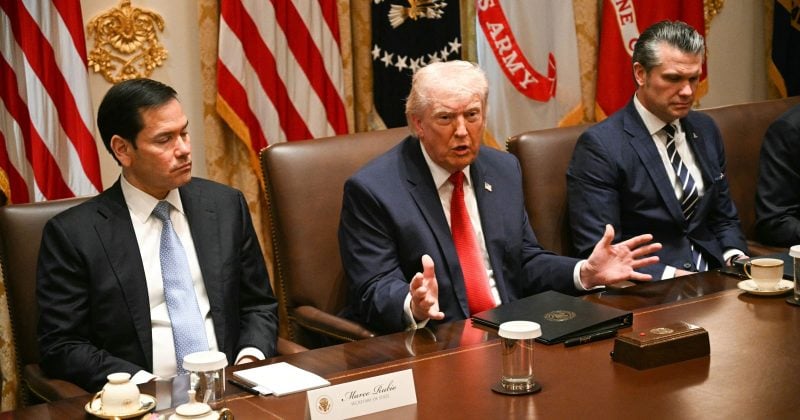
President Trump and Iranian officials have finalized a memorandum of understanding to end a four-month conflict that has rattled global markets and disrupted international shipping [2]. The agreement, confirmed Sunday, mandates an immediate end to military operations across all fronts, including Lebanon, and paves the way for the reopening of the Strait of Hormuz [2].
The deal follows months of volatile negotiations characterized by intermittent strikes and counterstrikes [1]. Under the terms, the U.S. will lift its naval blockade on Iranian ports, a move President Trump signaled by declaring, "Ships of the World, start your engines" [2]. While the full text remains unreleased, officials previously indicated the framework includes a 60-day cease-fire period [2]. A formal signing ceremony is scheduled for Friday in Geneva [2].
Despite the breakthrough, the agreement leaves the most contentious issues—specifically the future of Iran’s nuclear program and the status of U.S. sanctions—for future rounds of negotiation [2]. Administration officials had previously sought an indefinite commitment from Iran to dismantle its nuclear program, including the destruction of enriched uranium, but acknowledged that consistent compliance remains a significant hurdle [1].
The path to the agreement faced a late-stage collapse on Sunday after Israel conducted airstrikes in the southern suburbs of Beirut in response to Hezbollah rocket fire [2]. President Trump publicly criticized Israeli Prime Minister Benjamin Netanyahu for the timing of the strikes, calling for all parties to "stand down" [2]. The final deal was secured only after a last-minute mediation effort led by Qatar, with Iranian officials delaying their final approval until early Monday to avoid signing on the date of President Trump’s birthday [2].
The war, which was originally expected to last only six weeks, has cost billions of dollars and created significant supply chain pressures for commodities like fertilizer [1]. While the administration frames the deal as a step toward broader regional peace involving Israel and Gulf states, skepticism persists among regional observers regarding Iran’s long-term adherence to the terms [1].
With the immediate military campaign halted, the focus now shifts to whether the 60-day window will produce a lasting resolution or merely serve as a temporary pause in a deeply entrenched conflict. The ultimate success of the agreement rests on whether the two sides can navigate the unresolved nuclear and sanctions disputes before the cease-fire expires.
Coming upLIVEsee all →
Across the coverage
Coverage is mostly measured — 286 of 300 reports stay neutral.
Bullish 5
Neutral 286
Bearish 9
The Catalyst Brief
Know what’s about to move the market.
Every Monday — the token unlocks, Fed dates & catalysts set to move crypto and markets this week. So you’re never blindsided.
Free · 3-min read · one-click unsubscribe
Synthesized from 2 sources
- 01The U.S. and Iran Might Actually Have a DealThe Atlantic
- 02Iran War Live Updates: U.S. and Tehran Reach Framework for PeaceThe New York Times
AI-assisted synthesis by the TrendWatcher Editorial Desk · sourced from 2 outlets · Jun 15, 2026 · How we report
Published
May 17, 2026, 10:05 PM
Author
Editorial Team
Source
TrendWatcher AI (Enhanced)
Frequently asked · Bitcoin
Why is the price of Bitcoin dropping as of September 2026?
Bitcoin is dropping due to hot core inflation data, a high probability of a Federal Reserve rate hike, and four consecutive days of net outflows from U.S. spot Bitcoin ETFs as of September 11, 2026. Additionally, long-term holders have been selling into the $77,000 to $80,000 price range, creating a supply wall that limits upward movement.
What is the significance of the $82,000 level for Bitcoin?
The $82,000 level serves as a key resistance zone for Bitcoin because sellers have repeatedly pushed the price lower from this area, including a peak of $82,283 on September 3, 2026. Analysts and AI models indicate that Bitcoin must break and hold above this level, supported by strong ETF inflows, to confirm a more bullish trend.
How do ETF flows affect the price of Bitcoin?
Bitcoin spot ETF flows impact price because when ETFs redeem shares, authorized participants sell Bitcoin to fund those redemptions, resulting in direct spot selling. Conversely, strong inflows act as a source of passive buying that absorbs supply and can help Bitcoin break through resistance levels.
What is a golden cross in the context of Bitcoin?
A golden cross occurs when the 50-day moving average of Bitcoin rises above the 200-day moving average, which is generally viewed by market analysts as a bullish signal. Bitcoin formed its first golden cross since May 2025 following a recovery from its July 2026 lows.