Loading article…
Dao Crypto
Interfold launches CRISP protocol for private, coercion‑resistant
TrendWatcher AI (Enhanced)·107d ago·neutral
Most covered nowLIVEsee all →
Interfold’s open‑source CRISP protocol uses homomorphic encryption, zero‑knowledge proofs and threshold cryptography to enable secret, receipt‑free voting for
Interfold unveiled CRISP, a new open‑source voting protocol that promises fully private, coercion‑resistant ballots on public blockchains. The system, launched in May 2026, combines fully homomorphic encryption, zero‑knowledge proofs and distributed threshold cryptography to keep votes secret while still allowing transparent tallying [1].
Key takeaways
- CRISP encrypts votes, tallies them while still encrypted, and only reveals the final result [1].
- Zero‑knowledge proofs verify voter eligibility and vote validity without exposing individual choices [1].
- Distributed threshold cryptography splits decryption keys among “Ciphernodes,” preventing any single operator from accessing raw votes [1].
- The protocol is receipt‑free, eliminating proof that a voter cast a particular ballot and thwarting coercion or vote‑buying schemes [1].
- Interfold operates the project without a native token; the code is publicly available on GitHub [1].
How CRISP works
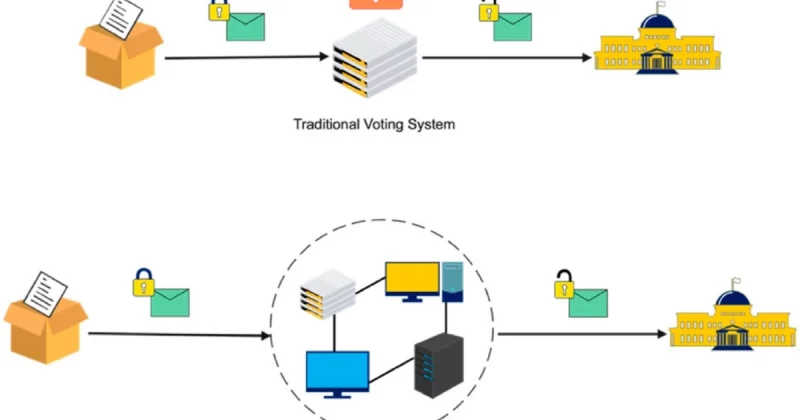
CRISP’s architecture rests on three cryptographic pillars. Fully homomorphic encryption (FHE) allows mathematical operations on encrypted data, meaning votes can be added together without ever being decrypted—a digital analogue of a sealed ballot box that counts its own contents. Zero‑knowledge proofs (ZKPs) then enable the system to confirm that each encrypted vote comes from an eligible participant and that the final tally is correct, all without revealing any individual vote. Finally, distributed threshold cryptography (DTC) spreads the decryption key across a network of incentivized node operators called Ciphernodes; only a threshold of these nodes can cooperate to decrypt the final result, removing reliance on a single trusted party.
The protocol also addresses known weaknesses in existing on‑chain voting methods. Traditional commit‑reveal schemes are vulnerable to manipulation during the reveal phase, while plain on‑chain voting leaves every vote publicly visible. By contrast, CRISP’s receipt‑free design means voters cannot produce evidence of how they voted, breaking the chain of coercion and vote‑buying. Its censorship‑resistant submission ensures votes cannot be selectively blocked, and the system supports anonymous participation, further protecting voter privacy.
Why it matters
Privacy and resistance to coercion are critical challenges for decentralized autonomous organizations (DAOs) that rely on token‑holder voting. Current practices expose votes to public scrutiny, enabling social pressure and market manipulation. CRISP’s combination of FHE, ZKPs and DTC offers a technically robust solution that could redefine how digital governance is conducted, making secret ballots feasible on transparent blockchains. A live proof‑of‑concept demo is already accessible at crisp.enclave.gg, allowing developers and community members to evaluate the protocol firsthand. As Interfold positions the project as infrastructure rather than a financial product—evidenced by its lack of a native token and open‑source release—the protocol may serve as a foundational layer for broader applications of encrypted computation beyond voting.
Coming upLIVEsee all →
Across the coverage
Coverage is mostly measured — 142 of 146 reports stay neutral.
Bullish 1
Neutral 142
Bearish 3
The Catalyst Brief
Know what’s about to move the market.
Every Monday — the token unlocks, Fed dates & catalysts set to move crypto and markets this week. So you’re never blindsided.
Free · 3-min read · one-click unsubscribe
Synthesized from 3 sources
- 01Interfold introduces CRISP for secure, privacy-preserving voting on blockchainCrypto Briefing
- 02Crisp achieves ISO/IEC 27001 and ISO/IEC 27017 certification to...Gocrisp
- 03Crisp EU GDPR compliance status | Crisp Knowledge BaseHelp
AI-assisted synthesis by the TrendWatcher Editorial Desk · sourced from 3 outlets · Jun 1, 2026 · How we report
Published
May 28, 2026, 11:51 AM
Author
Editorial Team
Source
TrendWatcher AI (Enhanced)
Frequently asked · Dao Crypto
What is the role of a Dao Crypto in decentralized finance?
A Dao Crypto acts as a governance structure for protocols, allowing token holders to participate in decision-making and protocol management. For example, Curve DAO uses its native token to enable holders to lock assets and vote on governance matters, while TRON DAO facilitates integrations with other protocols to expand ecosystem utility.
How does Dao Crypto governance impact leadership?
Dao Crypto governance allows community members to vote on the status of leadership roles, which can lead to the termination of personnel. As of the reported event involving the Ethereum Name Service, community delegates voted to remove a director of operations following public controversy over past statements.
Why did the price of a Dao Crypto token like CRV increase?
The price of the CRV token increased by more than 16% due to renewed investor interest in the decentralized finance sector and higher trading volumes on decentralized platforms. This movement reflects a broader trend of capital flowing back into established DeFi protocols as of the recent market period.
How do Dao Crypto projects like TRON DAO expand their ecosystems?
TRON DAO expands its ecosystem by integrating new assets and protocols, such as the recent partnership with Ethena Labs to bridge synthetic dollar tokens onto the TRON network. This integration allows users to utilize USDe and sUSDe within TRON-based DeFi platforms like JustLend DAO and SUN.io.