Loading article…
Bitcoin Hashrate
Bitcoin miners shift focus to power and AI as hash rate falls
TrendWatcher AI (Enhanced)·60d ago·neutral
Most covered nowLIVEsee all →
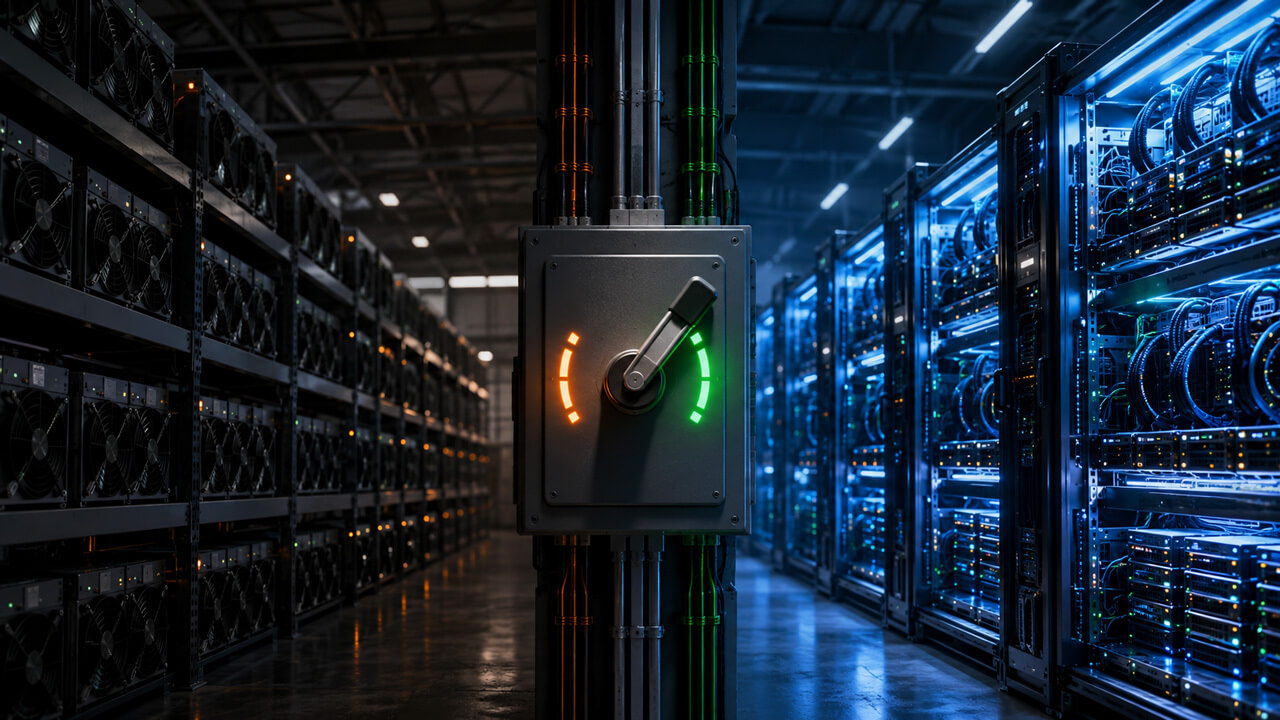
Bitcoin miners are repurposing electricity assets for AI workloads, with hash rate down 8‑9% and companies like MARA pivoting to data centers.
Bitcoin miners are redirecting their massive power assets toward artificial‑intelligence (AI) and high‑performance computing (HPC) workloads as the network’s hash rate and difficulty dip modestly. Fidelity’s mid‑year update notes an 8‑9% decline in both 30‑day average hash rate and mining difficulty, suggesting miners are allocating capacity to higher‑margin AI data centers [1].
Key takeaways
- Bitcoin’s 30‑day average hash rate and difficulty are each down about 8‑9% from recent peaks [1].
- MARA Holdings sold $1.5 billion of bitcoin and is investing in a 505‑MW Ohio power campus to support both mining and AI loads [2].
- Analysts estimate publicly traded miners control roughly 27 GW of power that could be redeployed for AI infrastructure [3].
- Several miner stocks outperformed Bitcoin in 2026, with a basket of crypto equities up 56% YTD while BTC fell 17% [4].
Hash rate dip signals a shift to AI‑ready power
Fidelity’s report highlights that the decline in hash rate and difficulty coincides with miners “redirecting power and infrastructure toward higher‑margin AI data center workloads” [1]. The trend is reflected in corporate actions. MARA Holdings, the second‑largest publicly traded Bitcoin holder, sold 20,880 BTC—about $1.5 billion—to retire debt and fund a large energy acquisition in Ohio [2]. The Long Ridge Energy & Power campus includes a 505‑megawatt gas‑fired plant and land capable of supporting more than 600 MW of AI and critical IT loads, with the existing mining footprint integrated into the site [2]. MARA’s disclosures indicate that roughly 90% of its non‑hosted mining capacity could eventually be repurposed for AI and IT infrastructure [2].
The broader sector is seeing similar moves. Bernstein research finds that 11 publicly traded Bitcoin miners collectively control a current and projected power portfolio of about 27 gigawatts, a resource that could become critical as AI data‑center demand accelerates [3]. The report points to IREN’s agreement with Microsoft, which could generate an annualized revenue run rate of roughly $3.7 billion from AI cloud services [3]. Wall Street’s semiconductor boom is also lifting miner stocks; TeraWulf, Hut 8, IREN, and Riot Platforms all posted double‑digit gains after announcing AI‑related acquisitions or partnerships [3].
Miner stocks outpace Bitcoin as AI pivot accelerates
Performance data from 10x Research shows a basket of crypto equities up 56% year‑to‑date, starkly contrasting Bitcoin’s 17% decline [4]. The rally is driven by “hyperscaler GPU deals to mega campus acquisitions,” underscoring the financial market’s view that miners’ power assets are more valuable when applied to AI workloads. Companies such as KEEL Infrastructure (formerly Bitfarms), Cipher Mining, IREN, and TeraWulf have each reported sizable stock jumps after announcing AI‑focused projects, ranging from power‑pipeline repurposing to new data‑center campuses capable of delivering up to 1 GW of capacity [4].
Why it matters
The convergence of Bitcoin mining and AI infrastructure reshapes both industries. For miners, the ability to flexibly allocate electricity to the higher‑margin AI market mitigates the volatility of Bitcoin rewards and hash‑rate competition. For the AI sector, access to ready‑made, reliable power reduces a key bottleneck identified by analysts, potentially accelerating the rollout of large‑scale AI models. As miners continue to invest in dual‑purpose assets—such as MARA’s Ohio campus and IREN’s Texas GPU deployment—the balance of capital between crypto mining and AI compute is likely to tilt toward the latter, influencing future valuations, regulatory focus, and the strategic direction of the Bitcoin ecosystem.
Coming upLIVEsee all →
Across the coverage
Coverage is mostly measured — 23 of 26 reports stay neutral.
Bullish 3
Neutral 23
The Catalyst Brief
Know what’s about to move the market.
Every Monday — the token unlocks, Fed dates & catalysts set to move crypto and markets this week. So you’re never blindsided.
Free · 3-min read · one-click unsubscribe
Synthesized from 4 sources
- 01Bitcoin Miners Face AI Squeeze as Hash Rate Flattens and Network Enters New Security Phase, Fidelity SaysBitcoin Magazine
- 02MARA Dumps $1.5B in Bitcoin as Miner Trades Treasury Hoard for AI Power BetBitcoin Magazine
- 03Bitcoin mining stocks jump as AI infrastructure boom boosts sector outlookCoinTelegraph
- 045 Bitcoin Miner Stocks Crushing BTC as AI Infrastructure Spending ExplodesBeInCrypto
AI-assisted synthesis by the TrendWatcher Editorial Desk · sourced from 4 outlets · Jun 1, 2026 · How we report
Published
May 29, 2026, 02:30 PM
Author
Gino Matos
Source
TrendWatcher AI (Enhanced)
Frequently asked · Bitcoin Hashrate
What is Bitcoin hashrate?
It is a measure of the total computing power currently connected to the Bitcoin network, used by miners to validate transactions and add new blocks.
Why do miners disconnect their equipment?
Miners may disconnect equipment when Bitcoin's market price falls below their production costs, making operations unprofitable.
How does new mining hardware impact the network?
New, more efficient hardware increases the total network hashrate, which in turn raises mining difficulty and necessitates further hardware upgrades to maintain profitability.