Loading article…
Crypto Payments
CFTC greenlights first US Bitcoin perpetual futures
TrendWatcher AI (Enhanced)·59d ago·neutral
Most covered nowLIVEsee all →
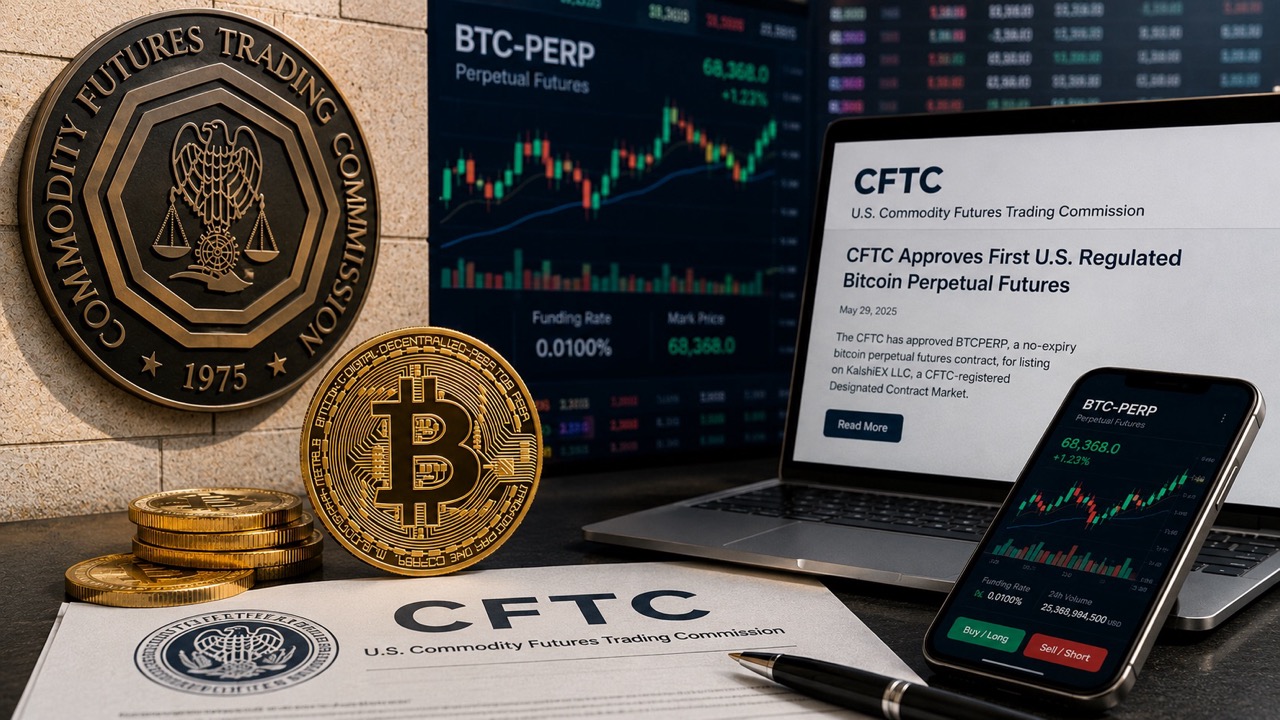
The CFTC approved Kalshi’s BTCPERP and gave Coinbase a no‑action letter, opening regulated Bitcoin perpetual contracts to US traders.
The U.S. Commodity Futures Trading Commission (CFTC) approved the first Bitcoin perpetual futures contract on a U.S.-registered exchange, KalshiEX’s BTCPERP, and simultaneously issued a no‑action letter to Coinbase’s derivatives subsidiary, allowing it to route similar products through its offshore arm [1].
Key takeaways
- The CFTC’s approval makes Bitcoin perpetual futures legal on a U.S.-regulated exchange for the first time [2].
- Coinbase received a no‑action letter permitting it to offer crypto perps using Bitcoin, Ether and stablecoins as margin collateral [2].
- Offshore platforms such as Binance, Bybit and Hyperliquid currently handle over $50 billion in daily perpetual futures volume, but are not CFTC‑registered [2].
- Kalshi’s BTCPERP is a cash‑settled contract that trades 24/7 and uses a funding mechanism tied to spot prices [1].
- The decision splits regulatory pathways: domestic listings on CFTC‑registered exchanges versus offshore products treated as foreign futures [1].
CFTC’s historic approval and Coinbase’s bridge
On May 29, 2026 the CFTC granted KalshiEX formal approval for its BTCPERP contract under the Commodity Exchange Act, marking the first time a Bitcoin perpetual futures product can be listed on a U.S.-registered exchange [2]. The contract has no expiration date, settles in cash, and employs a funding‑rate system that keeps its price aligned with the spot Bitcoin market [1]. CFTC Chair Michael Selig called the move “historic,” saying it charts a path for one of the most liquid crypto segments to exist within the U.S. regulatory framework [1][2].
Coinbase’s situation differs. The same day the CFTC issued a no‑action letter to Coinbase Financial Markets (CFM), allowing the subsidiary to route perpetual futures through Coinbase Bermuda. This permission lets U.S. customers access Bitcoin, Ether and stablecoin‑collateralized perps, but the products remain classified as foreign futures rather than domestically approved contracts [2]. In effect, Coinbase is building a regulated bridge to offshore markets, while Kalshi is bringing the product onshore.
Market reaction and the offshore backdrop
The approval sparked immediate market moves: Coinbase shares rose about 4 % and Robinhood jumped 11 % following the news [1]. Hyperliquid, a major player in the perpetual futures space, surged over 30 % to a new all‑time high, while the HYPE token outperformed Bitcoin by 270 % year‑to‑date [1]. Despite the domestic green light, offshore platforms such as Binance, Bybit, OKX and Hyperliquid collectively process more than $50 billion in perpetual futures volume each day, operating without CFTC registration and technically inaccessible to U.S. residents [2].
Why it matters
The CFTC’s decision creates the first regulated avenue for U.S. traders to access Bitcoin perpetual futures, a product that dominates global crypto derivatives trading. By separating domestic and offshore pathways, the commission signals a willingness to integrate high‑volume crypto instruments into the U.S. financial system while maintaining oversight. The next steps will involve Kalshi’s launch timeline, potential additional approvals for other crypto perps, and how Coinbase’s bridge may influence U.S. participation in the offshore market. Market participants will watch for further guidance on margin collateral, funding mechanisms, and compliance requirements as the regulatory landscape evolves.
Coming upLIVEsee all →
Across the coverage
Coverage is mostly measured — 126 of 132 reports stay neutral.
Bullish 6
Neutral 126
The Catalyst Brief
Know what’s about to move the market.
Every Monday — the token unlocks, Fed dates & catalysts set to move crypto and markets this week. So you’re never blindsided.
Free · 3-min read · one-click unsubscribe
Synthesized from 2 sources
- 01Morning Minute: HYPE Soars as CFTC Gives Perps Green LightDecrypt
- 02The US Just Legalized Bitcoin Perps: Here Is What That Means for...
AI-assisted synthesis by the TrendWatcher Editorial Desk · sourced from 2 outlets · Jun 3, 2026 · How we report
Published
May 29, 2026, 06:10 PM
Author
Liam 'Akiba' Wright
Source
TrendWatcher AI (Enhanced)
Frequently asked · Crypto Payments
When will Sberbank's crypto services become available?
Sberbank plans to debut its Bitcoin and crypto wallet and digital asset custody service by December, according to Interfax.
What is the purpose of NectarPay's platform?
NectarPay enables merchants to accept Bitcoin, TEXITcoin, USDC and other digital currencies with zero fees, non‑custodial settlement, and sub‑second processing.
How does Coinbase view the relationship between crypto and AI?
Coinbase CEO Brian Armstrong asserts that crypto provides the financial rails needed for AI agents, describing the two as complementary technologies.
Are there any restrictions on crypto use in Russia?
Crypto use as a payment method has been illegal in Russia since 2022, though it is allowed for international settlements under recent legislation.
What advantages does NectarPay claim over traditional card processing?
NectarPay claims zero transaction fees, no chargeback exposure, and settlement times under a second, compared with typical card fees of about 2.9% plus 30 cents and settlement periods of two to seven days.