Loading article…
Liquidation Crypto
CFTC Approves First US Bitcoin Perpetual Futures
TrendWatcher AI (Enhanced)·105d ago·neutral
Most covered nowLIVEsee all →
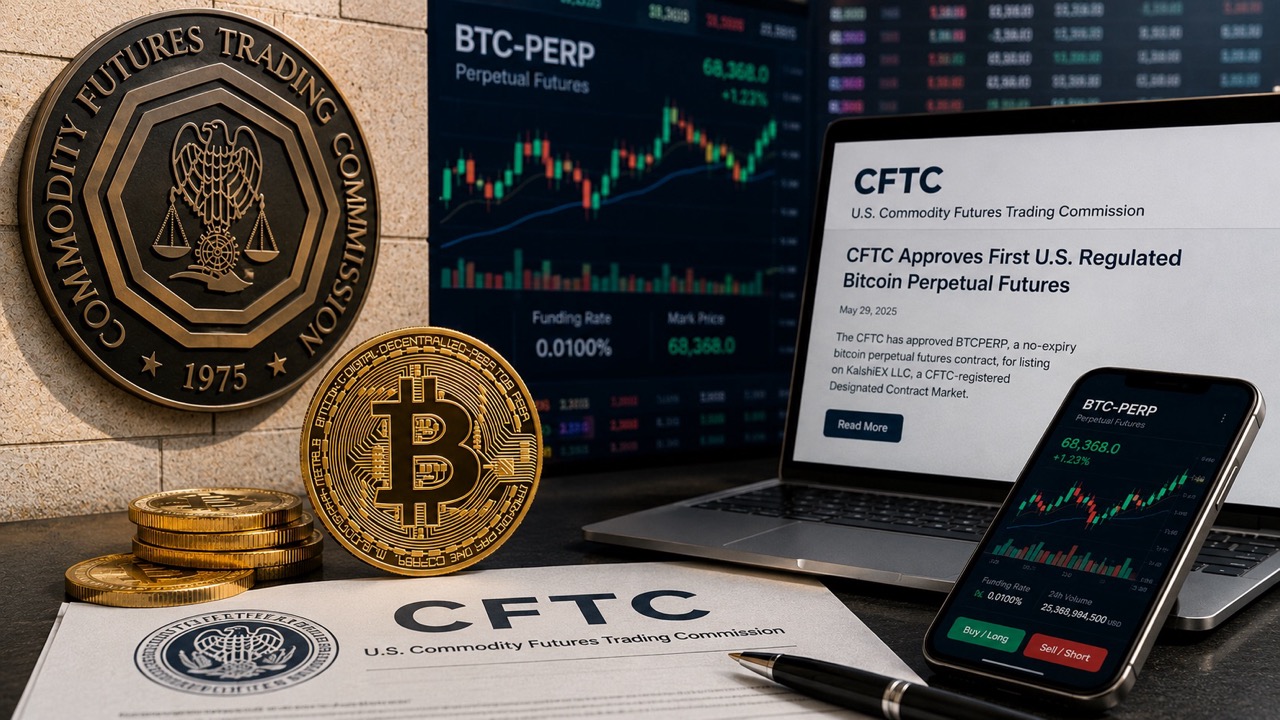
The CFTC approved the first Bitcoin perpetual futures contract on a U.S.-regulated exchange via Kalshi, while granting Coinbase relief for offshore access.
The Commodity Futures Trading Commission (CFTC) has approved the first Bitcoin perpetual futures contract to trade on a U.S.-regulated exchange, marking a significant shift in the regulatory landscape for crypto derivatives [1]. The agency granted approval to KalshiEX for its BTCPERP contract on May 29, while simultaneously issuing a no-action letter to a Coinbase subsidiary to connect U.S. customers to offshore perpetual markets [1][2].
Key takeaways
- The CFTC approved KalshiEX’s BTCPERP on May 29, marking the first Bitcoin perpetual futures contract on a U.S.-regulated exchange [1][2].
- Coinbase received a no-action letter allowing its derivatives subsidiary to route U.S. customers to offshore perpetuals using crypto as collateral [1][2].
- Bitcoin perpetuals are the most traded crypto derivative globally, with daily volumes exceeding $50 billion on platforms like Binance and Bybit [2].
- Market reaction included a surge in Hyperliquid’s HYPE token to an all-time high, while broader crypto majors fell 6% on the week [1].
Distinct Regulatory Pathways for Kalshi and Coinbase
The CFTC has established separate regulatory pathways for crypto perpetuals, distinguishing between domestic listings and offshore products [1]. Kalshi received a formal Order for Approval under Section 5c(c)(4) of the Commodity Exchange Act for a cash-settled contract that trades 24/7 and utilizes a funding mechanism tied to spot prices [1][2]. The exchange has opened a waitlist and expects to launch within a month [2].
Coinbase’s approval differs significantly; the no-action letter allows its Coinbase Financial Markets subsidiary to route perpetual futures through Coinbase Bermuda, treating them as foreign futures products [1][2]. This permits U.S. customers to access these offshore products using Bitcoin, Ethereum, and stablecoins as margin collateral, effectively creating a regulated bridge to global markets rather than a domestic listing [1][2].
Market Reaction and Offshore Competition
CFTC Chairman Michael Selig described the approval as a "historic action" that charts a path for one of the most liquid segments of the crypto asset markets to exist within the U.S. regulatory framework [1][2]. Markets reacted immediately, with Coinbase shares gaining 4% and Robinhood jumping 11% following the news [1]. Conversely, major cryptocurrencies like Bitcoin and Ethereum fell 6% on the week, while the token associated with decentralized exchange Hyperliquid (HYPE) surged over 30% to a new all-time high [1].
There is debate regarding the impact on Hyperliquid, as the approval opens the door to direct competition from U.S.-regulated entities [1]. However, the offshore market remains massive
Coming upLIVEsee all →
Across the coverage
Coverage is mostly measured — 27 of 37 reports stay neutral.
Bullish 1
Neutral 27
Bearish 9
The Catalyst Brief
Know what’s about to move the market.
Every Monday — the token unlocks, Fed dates & catalysts set to move crypto and markets this week. So you’re never blindsided.
Free · 3-min read · one-click unsubscribe
Synthesized from 2 sources
- 01Morning Minute: HYPE Soars as CFTC Gives Perps Green LightDecrypt
- 02The US Just Legalized Bitcoin Perps: Here Is What That Means for...Dailycoinpost
AI-assisted synthesis by the TrendWatcher Editorial Desk · sourced from 2 outlets · Jun 2, 2026 · How we report
Published
May 29, 2026, 06:10 PM
Author
Liam 'Akiba' Wright
Source
TrendWatcher AI (Enhanced)
Frequently asked · Liquidation Crypto
What triggers a crypto liquidation?
A liquidation is triggered when the market price moves against a leveraged position beyond the trader's margin threshold, forcing the exchange to automatically close the position.
Why do liquidations often affect long positions more than short positions?
Liquidations disproportionately impact long positions when the market experiences a sudden, broad-based sell-off, as these positions become overcrowded and vulnerable to price drops.
Does 24/7 trading reduce market risk?
Sources indicate that continuous trading does not remove risk but rather redistributes it, often concentrating it in overnight or weekend hours when institutional liquidity is lower.
What is the role of funding rates in crypto trading?
Funding rates are used in perpetual futures to keep the contract price aligned with the spot price; when they skew heavily positive, it often indicates overcrowded bullish positioning.